


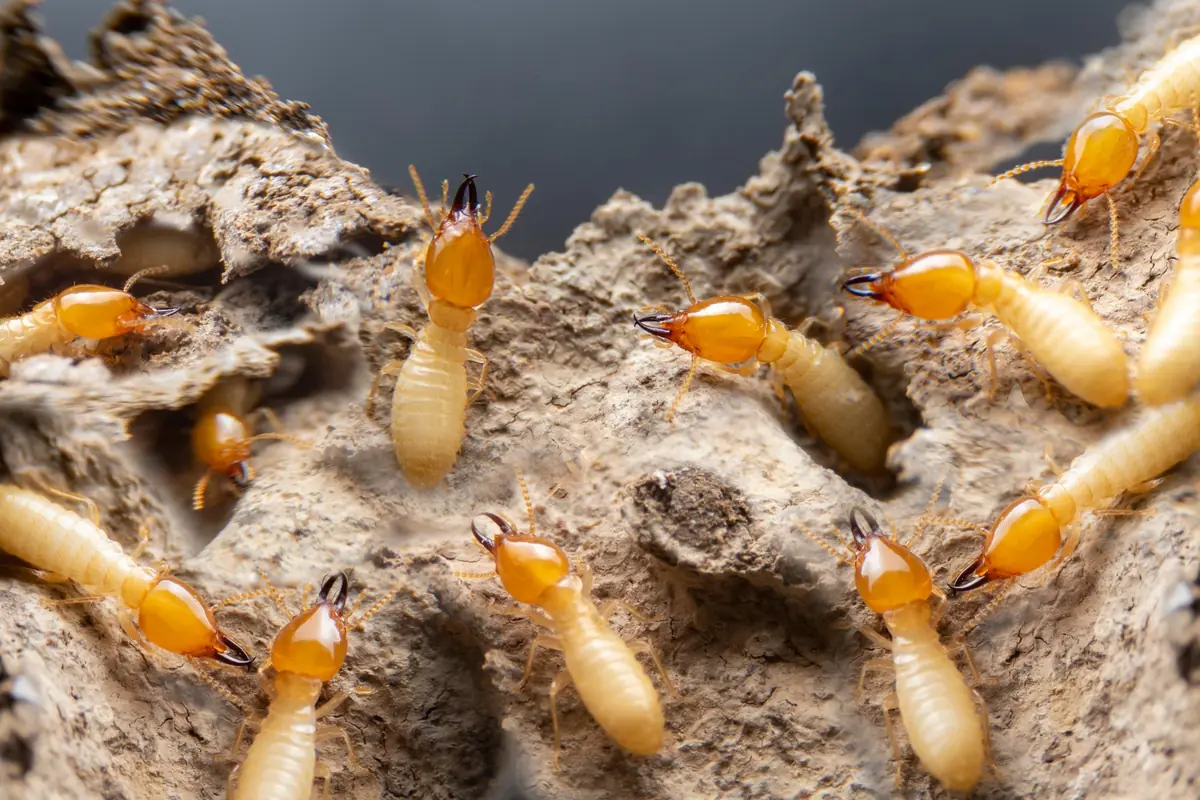
They live in the soil, travel inside mud tunnels and eat wood from the inside out. By the time most people see one, the colony has been working in the house for a long time.
Subterranean termites are social insects that nest underground and come up into buildings to feed on wood and anything else made of cellulose: door frames, skirting boards, built-in cupboards, roof timbers, paper, cardboard and even the backing of carpets. They need moisture and hate open air, so they move inside the timber they're eating or inside tunnels of soil and saliva they build up walls and along foundations. That's why the damage goes unnoticed for so long. A skirting board can look perfect and be paper-thin behind the paint.
They're found along the whole Garden Route coast and in the Klein Karoo, in old houses and new ones, and they are the most destructive pest we deal with in buildings.
What they look like
A colony has different castes, and you'll rarely see all of them.
- Workers are small, soft and pale cream, almost translucent, a few millimetres long. They do the eating. If you break open damaged timber and see pale insects that scatter from the light, those are workers
- Soldiers look like workers but have a larger, darker, hardened head with strong jaws. They guard breaches in the tunnels
- Winged reproductives (alates) are brown to black, with four long wings of equal length that break off easily. These are the "flying ants" that pour out of a crack after rain
Signs of termites in a house
- Mud tubes. Pencil-thick tunnels of soil running up a wall, a foundation, a pipe or the back of a cupboard. Break a piece open: if it's damp inside or rebuilt within days, the colony is active
- Swarms indoors. Winged termites coming out of a crack in the floor, a skirting or a window frame, especially on a warm, humid evening after rain
- Discarded wings. Piles of small, equal-sized wings on windowsills and floors
- Hollow timber. Skirtings, door frames or floorboards that sound hollow when tapped or that a screwdriver pushes straight into
- Bubbling paint or soil in cracks. Paint that blisters over timber, or fine soil packed into cracks and joints where it shouldn't be
- Damaged stored items. Boxes, books or papers stored on the floor of a garage or store room that turn out to be eaten from below
Termites or flying ants?
On a humid evening it's easy to mix them up. Termites have a straight, thick waist, straight antennae, and four wings of equal length. Ants have a narrow pinched waist, elbowed antennae, and front wings much longer than the back ones. Our guide to flying ants or termites has a side-by-side comparison. If in doubt, collect a few in a jar and send us a photo.
Why they're worth taking seriously
Termites don't stop on their own. A mature colony keeps feeding as long as it has a route into the building, and because the damage is hidden, it's usually found by accident: a door frame that crumbles when a hinge is replaced, a cupboard that collapses, a roof truss that sags. Repairs to structural timber, floors and joinery cost far more than treatment. Most home insurance policies exclude damage caused by insects and vermin, so it's usually the owner who pays.
How they're treated
Treatment creates a chemical barrier in the soil around and under the building, so termites travelling up from the colony pass through it. For an existing house that means treating the ground along the outside walls and, where needed, drilling through floors, paving or slabs to reach the soil beneath. Active mud tubes and damaged timber are treated at the same time. For a new building, the soil is treated before the slab is cast, which is called soil poisoning and is far easier and cheaper than treating later.
Our termite control page sets out how we treat them, and there are local pages for termites in George, Knysna, Plettenberg Bay and Mossel Bay.
What you can do in the meantime
Don't break open all the mud tubes or spray the termites you can see with a household insecticide. The colony simply builds new tunnels somewhere else, and it makes it harder for us to find the active routes. Leave things as they are, take photos, and call us. Moving firewood, timber offcuts and cardboard away from the walls, and fixing leaking taps and gutters that keep the soil wet against the house, helps make the house less attractive.
The termites eating the lawn are usually a different species altogether. See harvester termites.
Frequently asked questions
What do subterranean termites look like?
Workers are small, soft and pale cream. Soldiers have a larger dark head with jaws. The winged reproductives that swarm after rain are brown to black with four equal-length wings.
What are the mud tubes on my wall?
Pencil-thick tunnels of soil that subterranean termites build to travel between the ground and the wood they're eating. If a broken tube is rebuilt within days, the colony is active.
Do termites eat anything other than wood?
Yes. They eat anything containing cellulose, including paper, cardboard, books, and the backing of some carpets, which is why boxes stored on a garage floor are often the first thing damaged.
When do termites swarm?
Usually on warm, humid evenings after rain, when the winged reproductives leave the colony to start new ones. Wings left on windowsills are a common sign.
Should I spray the termites I can see?
No. Spraying the visible ones barely touches the colony and makes it build new tunnels elsewhere. Leave the tubes, take photos and have the house inspected.
Is termite damage covered by home insurance?
Usually not. Most policies exclude damage caused by insects and vermin, so check yours, and treat early to keep repair costs down.