


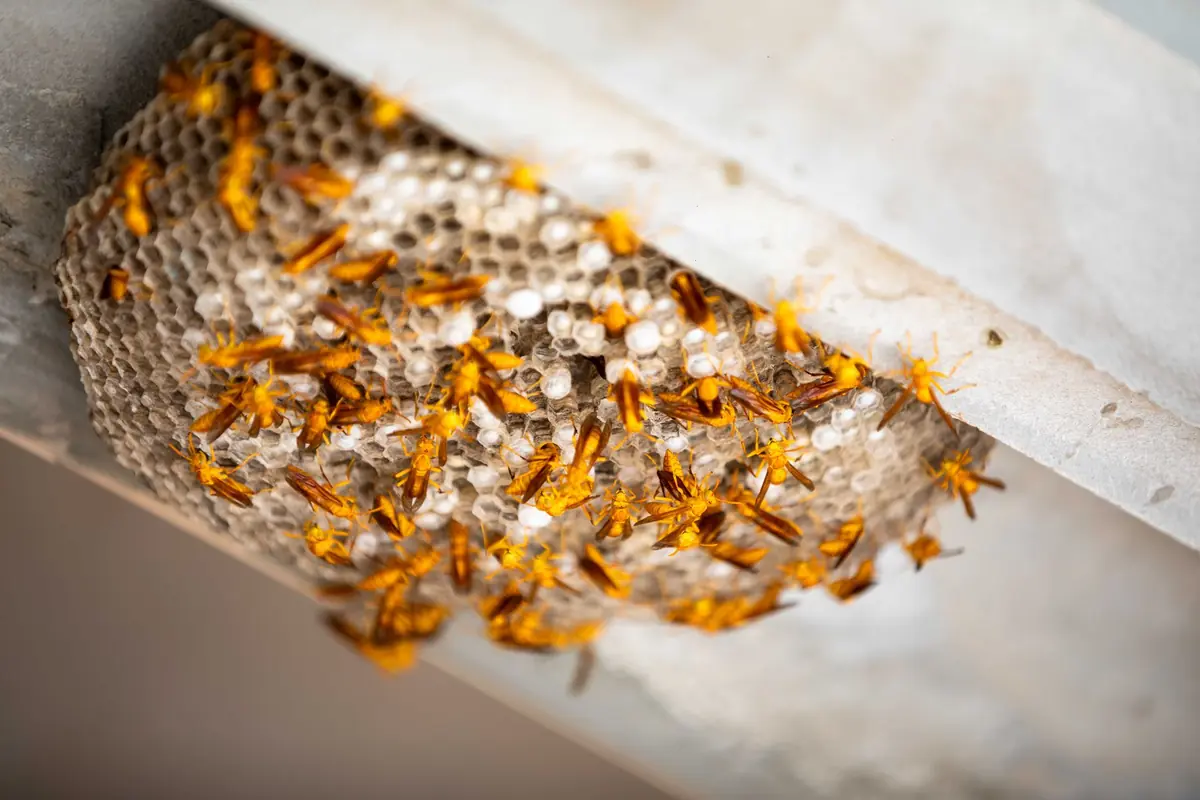
A grey papery nest above the front door, wasps hanging around the braai, a child stung by the pool. Here's how we deal with it, and what you can safely leave alone.
A wasp nest close to a door, window, pool or play area should be treated and removed, ideally early in the season while it's still small. A small nest at the bottom of the garden, well away from people, can often be left alone. The deciding question is how likely someone is to brush past it or bump it. Wasps defend their nest, and paper wasps in particular sting quickly when a nest is disturbed.
We take down wasp nests at homes, guest houses, schools and farms from Mossel Bay to Plett and up into the Klein Karoo.
Which wasps are you seeing?
- Paper wasps. Long-legged, slender wasps, usually brown or yellow and black, that build open grey nests of papery cells hanging from a single stalk. You find them under eaves and gutters, in window and door frames, in shrubs and hedges, under garden furniture and inside meter boxes. These are the wasps most people meet around the house. In Afrikaans you'll hear them called perdebye
- Mud daubers. Solitary wasps that build small mud tubes or pots on walls and ceilings and stock them with paralysed spiders. They rarely sting and are mostly a cleaning nuisance
- German wasps. An invasive species established in parts of the Western Cape. They nest in cavities and underground, in a closed paper ball, and scavenge meat and sweet food, which makes them a menace at outdoor meals
Our wasp profile has more on each.
How we remove a wasp nest
- Find every nest Paper wasps often build several nests around one house: under the eaves on different sides, in the garage, behind shutters. Treating one and missing three is common, so we walk the whole outside.
- Treat at the right time Nests are treated when most of the wasps are home, usually early morning or late afternoon, with a product that reaches into the cells.
- Take the nest down Once the wasps are dead, the nest is removed, so the cells and the larvae inside don't attract other insects and the spot is clean.
- Advice on the site Some spots get rebuilt year after year: a sheltered corner of the roof, a gap behind a shutter. We'll show you where and what helps.
Don't try this
- Spraying a large nest with a garden hose or a household can from close up, especially in the middle of the day when the wasps are active
- Knocking a nest down with a broom. You'll have a cloud of angry wasps and no way to get away from them on a ladder
- Burning a nest under the eaves, which is how a wasp problem becomes a fire
Very small, newly started nests, the size of a coin, are a different matter. If one is in reach at ground level, a quick early morning knock-down is often enough.
Wasps or bees?
Wasps are smooth and shiny with a narrow waist. Bees are fuzzy, build wax comb inside a cavity, and fly in and out of one entrance in a steady stream. If it's bees, read about bee removal instead, because the approach is completely different.
When wasps are worst
Nests start small in spring, when a single queen begins building. By late summer a paper wasp nest can have dozens of cells and a lot of adults, and that's when most stings happen. Holiday homes are a classic spot: a house empty since Easter can have nests under every eave by December. Our holiday home pest control visit includes checking for them before you arrive.
Restaurants, schools and guest houses
Wasps are attracted to sweet drinks, fruit and meat, which puts them right where people eat outside. A restaurant terrace, a school tuck shop or a guest house breakfast patio can have wasps at every table by late summer, and a sting to a customer or a child is a real risk. For these places, a check of the eaves, pergolas, umbrellas and play equipment in early spring, when nests are tiny, prevents most of the trouble. Nests found then are small and quick to remove, and the site doesn't have to close an outdoor area in January. Keeping bins closed and clearing plates quickly helps too, because German wasps in particular are drawn to food scraps.
Wasp nest removal in your town
There are local pages for wasp removal in George, Plettenberg Bay and Oudtshoorn, each with its own local detail.
What it costs
Wasp jobs are priced on how many nests there are, how high they are, and whether they're hidden in roofs or walls. A couple of paper wasp nests under the eaves of a single-storey house is a quick job. Nests on a double-storey roofline or inside a cavity take longer. We'll give you a price once we know how many and where.
If someone has been stung and is having trouble breathing, swelling in the face or throat, or feels faint, get medical help immediately. For the nest itself, ring 044 012 5011 or let us know where it is.
Frequently asked questions
Should I remove a wasp nest myself?
Only a very small, newly started nest at ground level. Anything bigger, higher or near a door is safer left to us, because disturbed wasps sting and you may be on a ladder.
When is the best time to remove a wasp nest?
Early in the season, while the nest is small, and early in the morning or late in the afternoon, when most of the wasps are on the nest.
Will the wasps come back to the same spot?
Paper wasps often rebuild in the same sheltered spots year after year. Removing the old nest and keeping an eye on those spots in spring helps.
Are wasps dangerous?
Most stings are painful but not dangerous. For people who are allergic, a sting can be serious, and several stings at once are risky for anyone.
How can I tell a wasp from a bee?
Wasps are smooth, shiny and narrow-waisted and build grey papery nests in the open. Bees are hairy and build wax comb inside a cavity.
Do you remove the nest after treating it?
Yes, once the wasps are dead we take the nest down where it can be reached, so the larvae don't attract other insects.