


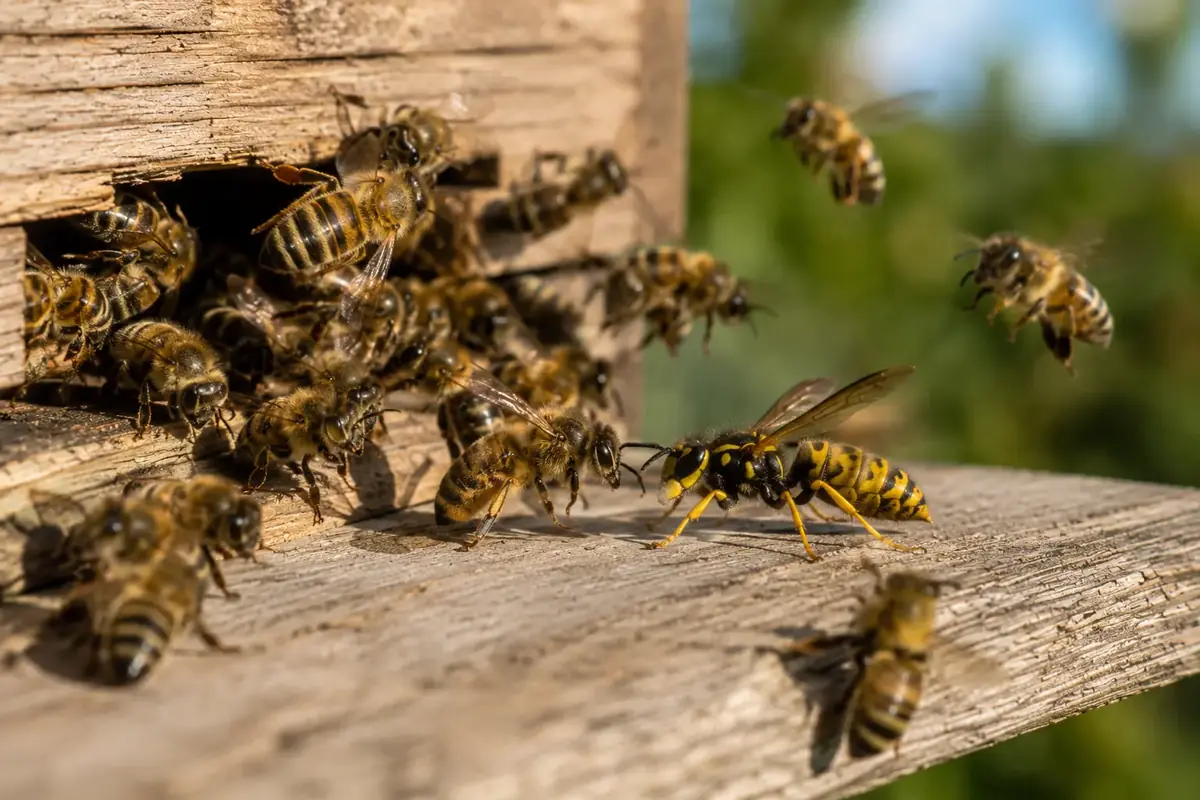
They pollinate our fynbos, our orchards and our gardens, and most of the time they're no trouble at all. The problem starts when a colony decides your wall cavity is the perfect place to live.
Honey bees live in colonies of thousands of workers with a single queen, building sheets of wax comb in a sheltered cavity where they store honey and raise their young. In the wild that cavity is a hollow tree or a rock crevice. Around people, it's often a wall, a roof space, a water meter box, a compost bin, an old fridge or a chimney. Honey bees are important pollinators and deserve protection, but a colony in a busy part of a house, school or business can be a real danger, especially to anyone allergic to stings.
In the Western Cape, including most of the Garden Route, the local bee is the Cape honey bee, a subspecies found only in this part of South Africa.
What they look like
- About 12 to 15 mm long
- Golden brown to dark brown, with darker bands across the abdomen
- Fuzzy and hairy, especially on the thorax, which helps them carry pollen
- Pollen often visible packed on the back legs as yellow or orange lumps
- They fly in a straight line in and out of the nest entrance
Why bees swarm
Swarming is how honey bee colonies reproduce. When a strong colony runs out of space, usually in spring and early summer when flowers are plentiful, it raises a new queen, and the old queen leaves with a large part of the workers. That cloud of bees settles nearby, often on a branch, fence or wall, and hangs in a cluster while scout bees search for a new home. A swarm is usually gentle because it has no comb, honey or young to defend. Within a day or two it moves on, and that's when it may choose your house. The first steps are in our swarm guide.
What attracts them to a building
Scouts look for a dry, dark, protected cavity of the right size with a small entrance. Wall cavities with a gap in the brickwork, roof spaces with a loose tile or open eaves, meter boxes with a missing cover, and spaces behind cladding all qualify. Old comb is a powerful attraction: a spot that's had bees before is far more likely to get them again.
Why colonies are a concern
An established colony defends its nest. Mowing near the entrance, vibration from building work, or a ball hitting the wall can set off a defensive response, with many bees stinging at once. For most people a single sting is painful but harmless. For someone allergic, one sting can cause a severe reaction, and multiple stings can be dangerous for anyone, especially children, older people and pets.
If you're stung
- Scrape the stinger out sideways with a fingernail or the edge of a card as quickly as possible. Honey bee stingers are barbed and keep pumping venom after the bee has gone
- Wash the area and use a cold compress to reduce swelling
- Move away from the area, because the smell of a sting alerts other bees
- Get medical help immediately for swelling of the face, lips or throat, difficulty breathing, dizziness, or many stings at once
Living with bees around you
Bees foraging on flowers in your garden are harmless if left alone, and they're good for the garden. A swarm hanging on a tree is usually best left for a day or two, with people and pets kept back. It's an established colony with comb, in or on a building, that needs professional removal, and that removal needs to include the comb as well as the bees, otherwise the honey melts, stains walls, and attracts the next swarm. Our bee removal page explains how we handle it, and we have local pages for George, Knysna and Oudtshoorn.
Frequently asked questions
Why are there suddenly thousands of bees in my tree?
It's probably a swarm resting while scouts look for a new home. Keep people and pets away. Swarms often move on within a day or two.
Are honey bees aggressive?
Not when foraging or swarming. They defend an established nest, though, and a disturbed colony can sting in large numbers.
How do I remove a bee sting?
Scrape it out sideways with a fingernail or the edge of a card as quickly as possible, then wash and cool the area.
Why do bees keep coming back to the same wall?
Old comb and the scent of a previous colony attract new swarms, and the gap they used is often still open. The comb must be removed and the entrance closed.
When do honey bees swarm?
Mostly in spring and early summer, when strong colonies run out of space and split.