

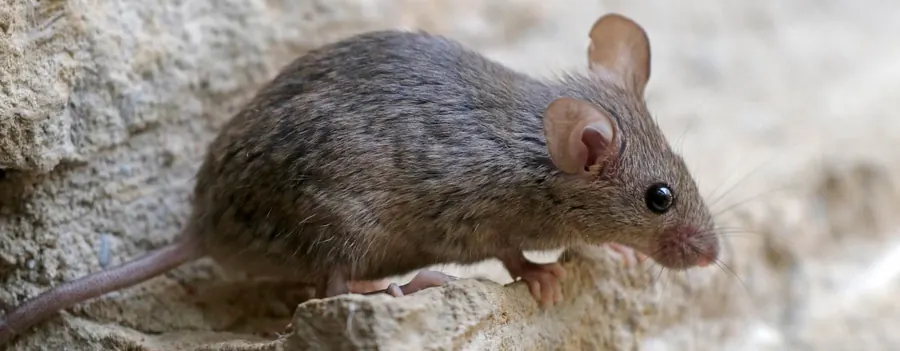
The quickest way to identify most household pests is by what they leave behind: droppings, bites, damage or a trail. Use the notes below to narrow it down. If you're still not sure, take a clear photo, ideally with a coin or ruler next to it for size, and WhatsApp it to us or call 044 012 5011. Knowing exactly what it is saves time and gets you the right treatment first time.
Rats or mice? Start with the droppings
Droppings are the most reliable clue, and you'll usually find them before you see the animal.
- Mice leave small droppings about the size of a grain of rice, pointed at the ends and scattered around wherever they've been moving, often in drawers, cupboards and along skirtings.
- Rats leave much bigger droppings, roughly raisin-sized or larger, usually in groups along their regular routes.
Noise helps too. Light, quick scratching in a cupboard is typical of mice. Heavier running and thumping in the ceiling at night usually means rats. Look for greasy rub marks along walls and beams, chewed wiring, gnawed food packaging and shredded material used for nests. Forest-edge homes often get roof rats climbing in from trees; homes near water and drains see more brown rats. See rodent control for how we deal with both.
German or American cockroach?
- German cockroach: small, about the length of a fingernail, light brown with two dark stripes just behind the head. Lives indoors in warm spots near food: behind fridges and stoves, in kettle bases, appliance motors and cupboard hinges. Breeds fast. This is the one that needs proper treatment.
- American cockroach: large and reddish-brown, often several centimetres long, with wings that let it fly short distances. Lives in drains, sewers and outbuildings, and wanders in at night through plugholes and gaps under doors.
Other signs: black, pepper-like droppings in cupboard corners, small brown capsule-shaped egg cases, and a musty smell. Our cockroach control page explains treatment.
Ants: follow the trail
Most ants in Garden Route homes arrive in lines, especially after rain or on hot days. Don't wipe the trail away straight off. Watch where it goes. One end leads to the food, the other to the way in, and sometimes to a nest in a wall, under paving or in a pot plant. Very tiny ants spread across the kitchen with no clear trail are often a species that nests inside the house, and spraying those can make them split into more colonies. Baits that ants carry home are the answer either way. More on insect control.
Flea bites or bed bugs?
Both cause itchy red bites, but the pattern is different.
- Flea bites are usually small, very itchy and clustered around the ankles and lower legs, because fleas jump up from carpets and pet bedding. If your dog or cat is scratching more than usual, fleas are the likely cause.
- Bed bug bites tend to appear on skin exposed during sleep, such as arms, neck and shoulders, often in a line or small group. Check mattress seams and bed frames for small dark spots, tiny shed skins and spots of blood on the sheets. Bed bugs often arrive in luggage, so think back to recent travel or guests.
Fleas are a standard treatment for us. If you think it's bed bugs, call us before you throw anything away, so we can confirm what it is.
Moths and weevils in the pantry
Stored product insects come into the house inside food: flour, rice, pasta, cereal, nuts, birdseed or pet food.
- Weevils are tiny dark beetles with a little snout, found crawling in rice, pasta and grain, or on the shelf around them.
- Pantry moths are small, dull moths fluttering in the kitchen, often at night. The giveaway is fine webbing in packets and small larvae in the food.
- Flour beetles are small reddish-brown beetles in flour and meal, sometimes with a fine dust at the bottom of the container.
For a household pantry, throwing out infested food, vacuuming the shelves and storing food in sealed containers often solves it. For warehouses, shops and feed stores, it can need fumigation.
Scorpions
Scorpions are mostly a Klein Karoo concern, around Oudtshoorn and Dysseldorp, though they turn up elsewhere too. They hide under rocks, wood piles, rubble and in dark corners of garages and outbuildings, and come out at night. A common South African rule of thumb is that scorpions with a thick tail and small pincers are the more dangerous kind, while those with big pincers and a thin tail are generally less so. Don't handle any of them. If someone is stung and feels unwell, get medical help straight away.
When to call us
- You're seeing droppings or hearing activity in the roof.
- Cockroaches are out in daylight, or you've found egg cases.
- Ants keep coming back after you've treated them yourself.
- Bites keep appearing and you can't work out why.
- You run a business that handles or stores food.
A single stray insect isn't an emergency, and we'll tell you honestly if it's something you can handle yourself. We've worked in the Garden Route for more than 25 years and we're SAPCA registered. For general enquiries, start with pest control in George, or simply call 044 012 5011 and describe what you've found.
Questions we get asked
Can I send you a photo of the pest?
Yes. WhatsApp us a clear photo, with a coin or ruler next to it if you can. It's often the fastest way to find out what you're dealing with.
How can I tell if rodents are still active?
Sweep up old droppings and check again in a day or two. Fresh droppings are dark and soft, old ones are grey and crumbly. New ones mean they're still around.
Are the big cockroaches worse than the small ones?
Not usually. The big American cockroaches mostly live in drains and wander in. The small German cockroaches breed indoors and are the bigger problem.
Why do I have weevils when I keep my kitchen clean?
Because they usually arrive inside the food itself. A packet can be infested before you buy it, and they spread to other packets from there.
Do you treat bed bugs?
Call us first and we'll confirm whether it really is bed bugs. Many bites people put down to bed bugs turn out to be fleas, which need a different approach.
Should I kill a scorpion I find in the house?
Keep your distance and keep children and pets away. Don't try to pick it up. If scorpions are turning up regularly, an inspection will find where they're sheltering.