


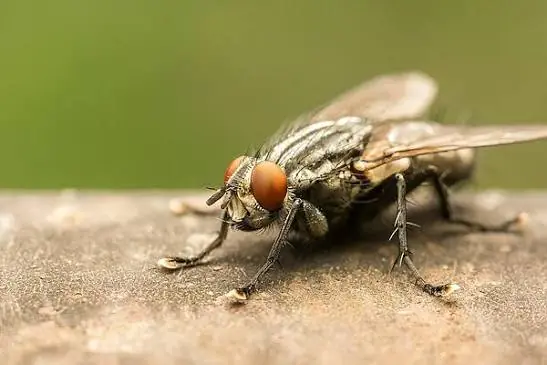
Swatting the ones in the kitchen won't change tomorrow. Every house fly you see came out of something wet and rotting within a short flight of where you're standing. Find that, and the problem shrinks fast.
Flies are controlled by finding and removing what they breed in, then treating the surfaces where adult flies rest. A house fly lays its eggs in moist organic matter: rubbish, food waste, manure, compost, grass clippings left in a heap, spilt feed, a dirty drain. In summer that egg can be a fly in about a week. Spraying the flies you can see without dealing with the source is like bailing out a boat without fixing the hole. It helps for a day.
We do fly control for restaurants, takeaways, butcheries, food factories, dairies, stables, feedlots, farmhouses and ordinary homes, from Mossel Bay to Plett and up over the passes into the Klein Karoo.
Which flies, and where they come from
- House flies. Grey, about 6 to 7 mm, with four dark stripes on the back. They breed in rubbish, food waste and manure, and they're the ones that land on your food. Our fly profile covers them in more detail
- Blowflies. Big, shiny blue or green flies that turn up when something has died, often a rat in the ceiling or a bird in a gutter. A sudden swarm of blowflies indoors is usually a sign of a carcass, which also points to a rodent problem
- Drain flies. Small and hairy, with wings held like a little roof, parked on the shower wall. They breed in the slime inside drains and overflows, and no spray will fix them until the drain is cleaned
- Fruit flies. Small, tan, red-eyed flies around fruit bowls, bins and bars. Anything sweet and going off feeds them: a forgotten banana, a sticky cooldrink ring, the muck under the bar mats
- Stable flies. Look like house flies but bite, mostly around livestock, horses and wet bedding
Telling these apart matters, because each one breeds somewhere different.
How we treat a fly problem
- Source inspection We look at bins, bin areas, drains, grease traps, compost, animal pens, manure heaps, feed spills and anything else that stays wet and rots. On farms and food premises this is where most of the time goes.
- Breeding site treatment Where breeding material can't be removed straight away, it is treated to stop larvae developing.
- Resting area treatment Flies rest on walls, ceilings, rafters, fences and the edges of bins, especially in the late afternoon. Spray those resting spots with a residual and every fly that settles there picks up a dose.
- Recommendations A short, practical list: bin collection, drain cleaning, screening, door curtains, manure handling. For businesses, it's written down so it can go in your hygiene file.
Restaurants and food premises
A kitchen with flies is a health inspection problem and a review problem. The usual sources are bin areas that aren't washed down, drains under prep tables, and grease traps. Fruit flies come from bars and fruit storage. We set up regular fly control as part of a commercial pest control contract, with service records your inspector and auditor will want to see. What belongs in that file, and what an inspector will ask about, is set out in our guide for food businesses.
At food premises, the bin area is the first place to look. Bins that are emptied but never washed, a drain beside them that holds dirty water, and lids that don't close properly will breed flies all summer. Washing bins and the slab they stand on every week, and keeping lids closed, does more than any treatment.
Farms and the Klein Karoo
In the hot, dry Klein Karoo summer, flies build up quickly around ostrich camps, kraals, dairies and feed stores. Around Oudtshoorn, the farms that keep flies down best manage manure and spilt feed every few days and treat resting areas on a schedule rather than waiting for a plague. On coastal dairy farms the problem is wet bedding and silage. Our farm pest control page covers fly work alongside rodents in feed stores.
On the coast, Mossel Bay brings its own version: fish waste, harbour bins and busy summer takeaways.
What you can do yourself
Keep bins closed and wash them out often, especially in summer when collection day feels a long way off. Bag food waste before it goes in the bin. Don't leave pet food standing outside. Turn the compost and don't add meat or cooked food. Fit screens and close doors when you're cooking. For drain flies, clean the drain with a stiff brush and hot water rather than pouring poison into it. For fruit flies, a jar with a little cider vinegar and a drop of dishwashing liquid catches a surprising number.
One honest point: if a house is getting flies only because the neighbour keeps chickens or there's a smallholding next door, treating your property will help, but it won't solve it completely. We'll tell you that rather than sell you a monthly service that can't work.
What it costs
Fly work is priced on the type of premises, the size of the area, how many breeding sources there are, and if you want one visit or a service that runs from spring to autumn. Fruit flies in one kitchen are a small job; a dairy, a feedlot or a food factory needs a programme. We'll come and look, then quote for what's actually there.
Call 044 012 5011 or use the form, and say what kind of premises it is: a kitchen, a stable yard, a dairy or a home.
Frequently asked questions
Where are all these flies coming from?
Somewhere close by is breeding them. Check the bins, any compost or manure, the dog run, and the roof space if the flies are big and shiny. Find the source and you've found the fix.
How quickly can a fly problem build up?
Fast. In summer a bin or manure heap that sits for a week can turn out a whole new generation, so regular clearing matters as much as treatment.
Do you treat drain flies?
Yes, but the drain has to be cleaned too. Drain flies breed in the slime inside the pipe, and spraying the flies on the wall won't stop the next batch.
Can fly control help a restaurant pass a health inspection?
Yes. Regular treatment, written service records and clear hygiene recommendations are exactly what inspectors and auditors look for.
Is fly treatment safe around food?
We treat resting surfaces away from food and prep areas, and food premises are treated with products and methods suited to them, with timing that suits your trading hours.
Do fly traps and zappers work?
They catch flies, and in a kitchen they're a useful extra. They don't stop the breeding, so on their own they rarely solve a real fly problem.