


In Oudtshoorn it's a scorpion in a shoe. On the coast it's a button spider in the garage or a rain spider on the curtain. Most are harmless. A few are not, and it pays to know which.
Keeping scorpions and spiders down comes down to two things: a residual barrier on the outside walls and the spots where they shelter, and a tidier yard that leaves them fewer hiding places. Neither responds well to a quick spray in the lounge. Scorpions in particular are tough: they can go months without eating and don't groom themselves the way insects do, so they pick up less of a treatment as they walk across it. That's why placement, and fixing the gaps they use, matters so much.
We treat homes, farmhouses, lodges and outbuildings for scorpions and spiders in the Klein Karoo and along the Garden Route.
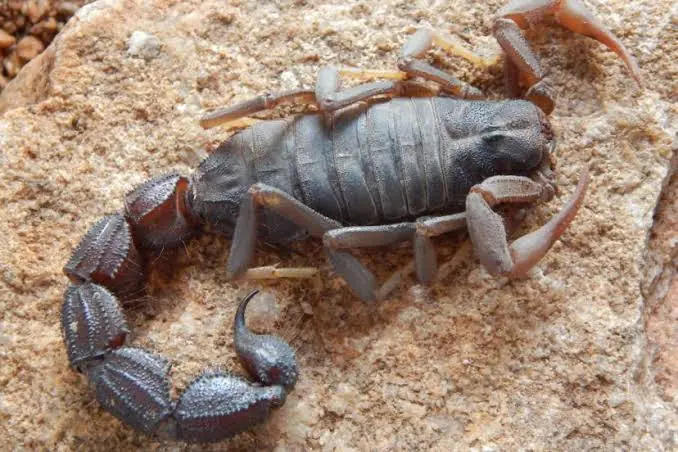
Scorpions: thick tail or big pincers?
South Africa has a simple rule that's worth teaching every child. Thick tail, thin pincers: dangerous. Thin tail, big pincers: much less so.
- Thick-tailed scorpions (Parabuthus species) have a heavy, thick tail and slender pincers. Their venom affects the nervous system, and a sting needs to be taken seriously, above all in young children and the elderly. They're common in the dry Klein Karoo
- Burrowing scorpions have big, crab-like pincers and a thin tail. They rely on their pincers, and while a sting hurts, it's usually no worse than a bee sting
Our scorpion profile has photos of both. Any sting from a thick-tailed scorpion, or any sting followed by numbness, difficulty swallowing or breathing, or muscle twitching, needs medical attention straight away.
The spiders worth knowing
- Button spiders. Glossy, round-bodied spiders with red or orange markings. Black button spiders are rarely seen but have a potent neurotoxic bite. Brown button spiders are common around houses, under garden furniture and in sheds, and are much less dangerous. Their egg sacs are a giveaway: spiky, like a tiny round seed pod. See our button spider profile
- Sac spiders. Small, pale yellow-green spiders that hunt at night and shelter in silk sacs in curtain folds and ceiling corners. A bite may leave a sore that's slow to heal
- Rain spiders. Big, hairy and alarming, especially when they come indoors before rain. They're harmless to people and eat other insects, so we leave them be
Spider bites, and what usually isn't one
Many sores that get blamed on spider bites turn out to be something else: an infected scratch, a skin condition, or a bite from a flea or mite. Real spider bites are uncommon, because most spiders only bite when they're trapped against skin, in a shoe, a glove or bedding. If a bite turns into a spreading, painful or slow-healing sore, see a doctor, and if you can, take the spider along in a jar. It helps the doctor, and it helps us know what we're treating for.
How we treat scorpions and spiders
- Walk the property We look at what's against the house: rock edging, woodpiles, rubble, stacked pots, creepers, gaps under doors, weep holes and cracks in the plaster. That's where scorpions and spiders shelter.
- Barrier treatment An odourless residual treatment around the foundations, door thresholds, window frames, weep holes and the edges of paving. Inside, the skirtings and dark corners where they come in.
- Outbuildings Garages, sheds, outside rooms and staff quarters get the same treatment. They're often where the real population lives.
- Webs and egg sacs Button spider egg sacs and webs in eaves, garages and garden furniture are removed so they don't hatch hundreds of young.
- Advice A short list of changes that keep them out, specific to your yard.
What makes the biggest difference
- Move woodpiles, bricks and rock edging away from the walls
- Close the gap under outside doors with a brush strip or a rubber seal
- Keep beds and cots a little away from the wall and stop bedding touching the floor
- Shake out shoes, boots and gloves left outside or on the floor
- Use yellow outside bulbs or move lights away from doors. White light attracts insects, which attract spiders and scorpions
- A UV torch at night shows scorpions glowing bright green-blue, which is the easiest way to find out how many you have
Klein Karoo homes
In and around Oudtshoorn and Dysseldorp, scorpions are part of life, and they're out in force on hot summer nights. Farmhouses with stone walls, outbuildings and stacked material in the yard need the most attention. New to the Karoo? Read our scorpion safety guide before the first heatwave.
On the coast, it's mostly spiders: button spiders in garages and under outdoor furniture, sac spiders in bedrooms, and rain spiders after a dry spell breaks. Spiders are often part of a broader insect control treatment.
What it costs
Spider and scorpion work is priced on the house and yard, how many outbuildings there are and how much clutter leans against the walls, along with whether you'd like a single treatment or one each summer. A town house is a short job. A farmhouse with sheds and staff quarters takes longer. We'll quote after a look.
Our number is 044 012 5011, or you can message us here. If you've caught a scorpion in a jar, a WhatsApp photo tells us exactly what you're dealing with.
Frequently asked questions
What does a spider and scorpion treatment involve?
A residual barrier around the outside walls, doors, windows and outbuildings, plus the dark corners, garages and storerooms inside where they shelter.
Do sprays kill scorpions?
A barrier treatment helps, but scorpions are harder to kill than insects. Removing their shelter near the house and sealing gaps under doors matters just as much.
Are button spiders dangerous?
Black button spiders have a potent bite and need medical attention, but they're shy and rarely seen. Brown button spiders, the ones usually found around houses, are far less dangerous.
Should I kill rain spiders?
There's no need. Rain spiders look frightening but are harmless to people and eat other insects. Catch it under a container and put it outside.
When is the best time to treat for scorpions?
Early summer, before the warm nights when they're most active. In the Klein Karoo, a second treatment later in the summer can help.
Someone's been stung. What now?
Sit them down, keep them as still and calm as you can, and get medical advice, particularly for a child, an older person, or a sting from a thick-tailed scorpion. Watch for numbness, twitching or trouble breathing.