


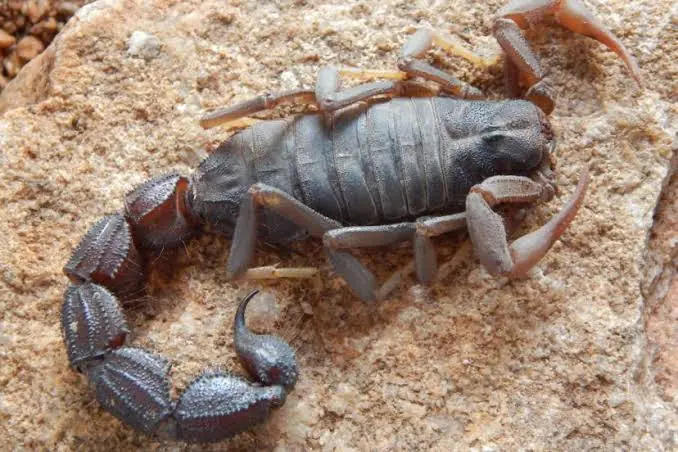
Pick up a scorpion with your eyes, not your hands, and look at two things: the tail and the pincers. That one glance tells you most of what you need to know.
Scorpions are eight-legged arachnids with a pair of pincers at the front and a segmented tail ending in a venomous sting. South Africa has a large variety of them, and they're common in the hot, dry Klein Karoo around Oudtshoorn, Dysseldorp, Calitzdorp and De Rust, and present along the coast as well. Most are not dangerous to healthy adults. A few, the thick-tailed scorpions, have venom that affects the nerves and can make a small child or a frail grandparent properly ill.
The rule of thumb
Thick tail and thin pincers: treat as dangerous. Thin tail and big, heavy pincers: much less dangerous.
Scorpions that rely on venom to subdue their prey have thick, powerful tails and small pincers. Scorpions that rely on strength have large, crab-like pincers and a thin tail. It's not a perfect rule, but it's a good one to teach children.
The main types
Thick-tailed scorpions
Larger scorpions with a heavy, thick tail, often darker at the end, and slender pincers. They live in dry, open areas, under rocks and in shallow scrapes, and some can squirt venom a short distance when threatened. A sting is very painful and can cause tingling and numbness spreading from the sting, muscle twitching, difficulty swallowing, a thick tongue, drooling and, in severe cases, trouble breathing. These are the scorpions to worry about.
Lesser thick-tailed scorpions
Small, often colourful scorpions with a moderately thick tail. They're common under rocks and bark and occasionally come indoors. Their sting is painful but usually less serious than the big thick-tails.
Burrowing and rock scorpions
Big pincers, thin tail. Burrowing scorpions dig deep holes in open ground. Rock scorpions are flat and live in cracks in rocks and walls. Stings hurt, but are generally no worse than a bee sting for most people.
Where they hide
Scorpions hunt at night and hide during the day. Around a house, that means:
- Under rocks, rock edging, bricks, paving stones and stacked pots
- In woodpiles, rubble and garden rubbish
- In cracks in old stone walls and outbuildings
- Under loose bark and in the bases of plants
- Inside shoes, boots, gloves, towels and clothing left on the floor
- Under beds and in dark corners, once inside
Getting in is easy for them: the gap under a door, a weep hole, the space where a pipe enters the wall. Rough plaster is no obstacle; they climb it.
A UV torch trick
Scorpions glow a bright greenish-blue under ultraviolet light. A cheap UV torch on a warm night shows exactly how many are around the house and where they're coming from, which makes it the best way to judge whether you have a problem.
If someone is stung
- Keep the person calm and as still as possible
- Apply an ice pack or cold compress to the sting
- Get medical help, especially for children, older people, anyone stung by a thick-tailed scorpion, or anyone showing numbness, twitching, difficulty swallowing or breathing
- If it's safe, take the scorpion, or a clear photo of it, to help identify it
Don't cut the wound or try to suck out the venom.
Keeping scorpions out
Shift the rock edging, the woodpile and any builder's rubble a few metres from the house. Put a seal along the bottom of every outside door. Pull beds slightly off the wall and keep duvets from trailing on the floor. And make shaking out shoes and clothes a habit. There's a family checklist in our Klein Karoo scorpion guide. Treating a band around the house and the outbuildings makes a real difference, and our scorpion and spider control and scorpion control in Oudtshoorn pages explain how we treat.
On farms and in rural homes, staff housing and outbuildings deserve the same attention as the main house. See farm pest control.
Frequently asked questions
How do I tell if a scorpion is dangerous?
Thick tail with thin pincers means potentially dangerous. Thin tail with big, heavy pincers means much less dangerous.
What should I do if a child is stung by a scorpion?
Keep the person still and calm, put something cold on the sting and get them to a doctor without delay, especially if it was a thick-tailed scorpion or they show numbness, twitching or trouble breathing.
Why do scorpions glow under UV light?
A substance in their outer skin fluoresces under ultraviolet light. A UV torch at night is the easiest way to find them.
Where do scorpions hide in the house?
In shoes, clothes and towels on the floor, under beds, in dark corners and in cracks near doors. Outside, under rocks, wood and rubble.
Are all scorpions dangerous?
No. Most South African scorpions cause a painful sting but no serious harm. The thick-tailed species are the ones to treat with caution.