


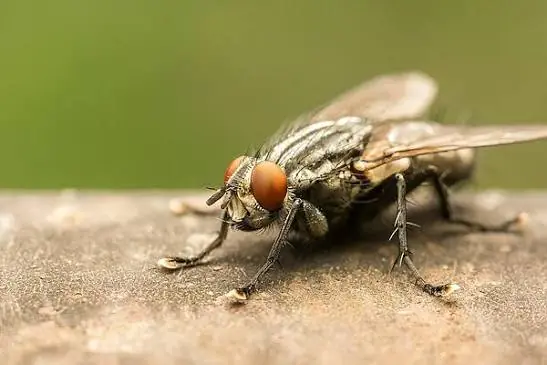
A fly lands on the dog's mess, then on your sandwich. That's not just disgusting, it's how flies spread germs. And every fly in the kitchen started life as a maggot somewhere nearby.
Flies are two-winged insects that develop from eggs into maggots and then into adults, and the species that bother us most around homes, restaurants and farms breed in rotting organic material: food waste, manure, dead animals and the slime in drains. Adults are attracted to the same things, as well as to our food, which is how they carry bacteria from one to the other. Controlling them is mostly about finding where they breed.
House flies
- About 6 to 7 mm long, grey, with four dark stripes running down the back
- Large reddish eyes
- Can't bite. They feed by spitting saliva onto food to dissolve it, then mopping it up
- Breed in rubbish, food waste, manure, compost, wet grass clippings and spilt animal feed
A female house fly lays batches of eggs in moist, rotting material, and in warm weather the maggots grow quickly, crawl away to drier ground to pupate, and emerge as adults within about a week. A single bin or manure heap left for a week in summer can produce a lot of flies.
Blowflies
- Larger, about 8 to 12 mm, with a shiny metallic blue, green or bronze body
- Loud and buzzy, often bumping against windows
- Breed in meat, fish, dead animals and pet food left out
A sudden appearance of blowflies indoors, often several at once at a window, almost always means something has died nearby: a rat or mouse in the ceiling or a wall cavity, a bird in the gutter, or meat in a bin. Once the carcass is found and removed, the flies stop. If you've had rodents recently, see roof rats.
Other common flies
- Fruit flies. Tiny, tan, with red eyes, around fruit bowls, bins, bars and drains, breeding in fermenting fruit and spilt drinks
- Drain flies. Small, grey, fuzzy and moth-like, sitting on bathroom walls, breeding in the slime inside drains and overflows
- Stable flies. The biters. Same size and colour as a house fly, but they draw blood, and they hang around horses, cattle and soggy straw
- Flesh flies. Grey with a checkered abdomen, breeding in carcasses and meat
How flies spread germs
Flies walk and feed on faeces, rotting food and carcasses, and then on our food and surfaces. Bacteria stick to their legs and body hairs and pass through their gut. They also spit saliva onto food to digest it and leave droppings wherever they rest. That's how flies spread the bacteria behind stomach upsets, which is why fly control is a food safety issue in kitchens, restaurants and food factories, not just a nuisance one.
Flies and the seasons
Flies breed fastest in heat. In the Klein Karoo summer, around ostrich camps, kraals and farm sheds, numbers can climb within days. Along the coast the peak is late summer, when holiday crowds and full bins coincide. In winter, numbers drop, but in sheltered buildings with a warm breeding source, flies can keep going all year.
Cutting them down at the source
- Bins with tight lids, washed out regularly, and food waste bagged before it goes in
- Pet food not left outside, dog mess picked up daily
- Compost turned and kept free of meat and cooked food
- Manure and wet bedding cleared every few days on farms and smallholdings
- Drains cleaned with a brush and hot water, not just doused with poison
- Screens on kitchen windows and doors kept closed during cooking
Our fly control page explains how we treat breeding sites and resting areas, with local pages for Mossel Bay and Oudtshoorn.
For restaurants and food businesses, flies are an inspection issue as much as a nuisance. If you run a kitchen, the restaurant and food premises guide sets out what a fly programme needs to show an inspector.
Frequently asked questions
How long does it take a fly to develop?
In warm weather, about a week from egg to adult. In cool weather it takes much longer.
Why are there big shiny flies at my window?
Blowflies indoors usually mean something has died nearby, often a rat or mouse in the ceiling or wall. Find and remove it and the flies stop.
Do house flies bite?
No. House flies can't bite. Stable flies, which look similar, do bite, mostly around animals.
How do flies spread disease?
They feed on faeces and rotting material, then land on food, carrying bacteria on their bodies and in their saliva and droppings.
Where do little flies in the bathroom come from?
Usually from the slime inside the drain or overflow. Cleaning the drain with a brush and hot water gets rid of their breeding site.