


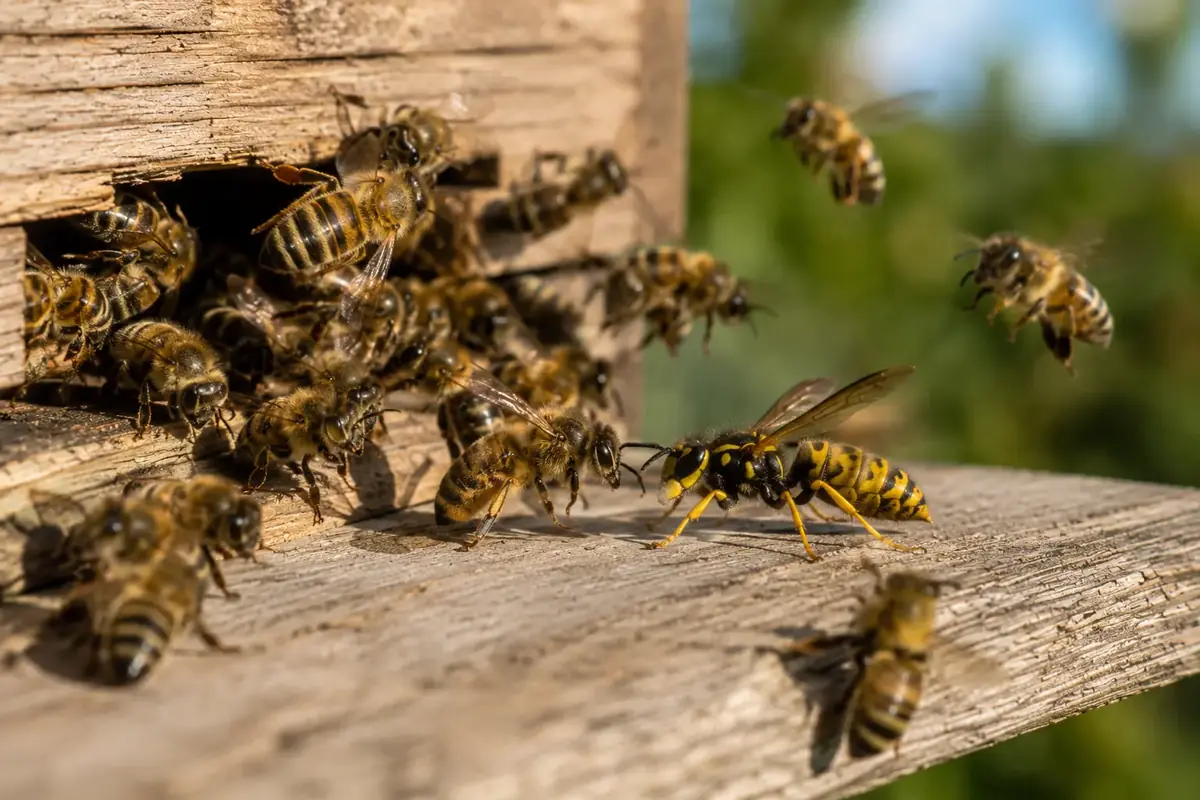
Every spring, swarms leave the forests and fynbos around George looking for a new home. A dry wall cavity in Heatherpark or a meter box in Fernridge will do nicely, as far as the bees are concerned.
Bees going in and out of one gap in your George house, all day and every day, means a colony has moved in. It has to come out together with all of its comb, and then the gap has to be closed. Killing the bees without taking out the comb is the expensive shortcut. Once nothing is fanning it, the wax softens in the summer heat, honey runs down inside the wall or through the ceiling boards, the smell carries, and next spring another swarm finds the same cavity by scent. A loose cluster of bees hanging from a branch or a gate is a different matter altogether. That's a swarm in transit, and if it's left alone it's usually gone within a day or two.
We take bee colonies out of houses, schools, churches, businesses and farm buildings throughout George, from the older suburbs under the mountain to the newer estates on the edges of town.
Why bees move into George homes
George is surrounded by indigenous forest, plantations, fynbos and farmland, all of which support a lot of wild honey bee colonies. Once the spring flowering gets going, strong colonies split, and the swarms that leave go looking for a dry, sheltered cavity. The town, with thousands of houses full of wall cavities, roof spaces and meter boxes, is right next door.
Where colonies settle in George houses:
- Wall cavities in double-brick walls, entered through a gap in the mortar or a weep hole
- Roof spaces under tiles or iron sheeting, entered at the eaves or a broken tile
- Water meter boxes at the front of the property, especially with a missing or loose lid
- Chimneys that aren't used in summer
- Compost bins, old fridges and stacked pots in the garden
- Trees with hollow trunks in older gardens
Hanging in the open, or flying into a gap?
Watch what the bees are doing for a few minutes. If they're bunched into a ball the size of a rugby ball or bigger, clinging to a branch, the gate or the side of the carport, and mostly sitting still, it's a swarm. Those bees have no home yet. They left an old colony with their queen and are waiting while scouts check out possible cavities. They're full of honey and seldom sting unless someone disturbs them. Keep the children and dogs back, resist the urge to hose them, and wait. Our bee swarm guide goes through it step by step.
If instead bees are taking off from and landing at one particular hole, in a wall, under a tile or at the edge of the meter box lid, and they're doing it every day, they have already built comb inside. You'll often see a few standing at the entrance fanning their wings. That's a colony. It will defend its comb, it will grow through the summer, and it isn't going anywhere.
What happens when we come out
We start by watching the entrance and tracing where the comb is likely to be, following the flight of the bees and listening against the wall or ceiling, where a big colony hums. Anyone who doesn't need to be there goes indoors or away, windows on that side are shut, and we suit up.
Whether the bees can go to a new home alive depends on the site. Comb we can reach cleanly and lift out in one piece gives the colony a chance. Comb wedged deep inside a cavity wall, or a colony that has been living in a roof for years, usually can't be taken out without destroying it. You'll hear our honest view before work starts, not after. Either way the comb comes out, because that is what stops the problem coming back.
Last, the gap gets closed. We seal what we can on the day, and where it needs a builder, such as a new length of fascia or some repointing, we tell you exactly what to ask for. In a roof, reaching the comb can mean lifting tiles or opening a bit of ceiling or fascia, and you'll know about that before we begin.
Schools, churches and businesses
A bee colony near a classroom, a playground, a church entrance or a shop door is a real risk, especially for anyone allergic to stings. We plan removals for after hours, weekends or holidays where possible, and keep the area clear while we work.
Mistakes that make a bee job worse
- Spraying insecticide into the entrance. It doesn't reach the comb, and the bees that survive stay agitated for days
- Plugging the hole with foam, paper or cement while the colony is inside. The bees chew through or find another exit, and that exit is often a downlight or a crack in a ceiling inside the house
- Hosing them. Water doesn't drown a colony inside a wall. It just makes every bee in it angry
- Opening up the wall or ceiling yourself to have a look
A person who has been stung many times, or who has swelling around the mouth or throat or trouble breathing after a sting, needs a doctor or a hospital urgently.
Keeping the next swarm out
Swarms start flying in George as the weather warms up in spring. Before then, take a slow walk around the outside of the house and look for any opening about the width of a pencil or bigger: unscreened weep holes, gaps where fascia boards have shrunk, open gable vents, a chimney without a cap, a cracked air brick, the meter box whose lid went missing years ago. A bit of mesh, a cap or some filler now costs far less than a removal in November.
When the bees are next door
Often the bees flying over your garden are living in the neighbour's wall or roof. You can't remove a colony from someone else's property, but you can let them know, and many neighbours are grateful to hear about it before the honey starts staining their ceiling. If the colony is on common property in a complex, the body corporate or managing agent arranges the removal. We're happy to talk to whoever owns the building.
How a bee removal is priced
No two bee jobs are alike, so we quote once we know what we're dealing with. The things that move the price are where the comb is, how long the colony has been there (an old colony has far more comb), the height and access, how much of the building must be opened, and whether we're sealing it afterwards. Bees in a meter box on the pavement are quick. A colony that has lived in the roof of a double-storey house for a few seasons takes a good deal longer.
For more background, see our bee removal page and the honey bees profile, and for other services across town, see pest control in George. Ring 044 012 5011. A photo of the entrance, taken from a safe distance and sent on WhatsApp, helps us plan, or you can book through the website.
Frequently asked questions
There are bees going in and out of our water meter box. What should I do?
Leave the lid shut and keep children and dogs away from it. A colony in a meter box is a quick job once we're there, and a lid that fits properly stops the next swarm moving in.
Is it safe to mow near a bee colony?
Not close to the entrance. The noise and vibration of a mower or weed-eater right beside a colony is a reliable way to set it off. Leave that patch until the bees are out.
Can you work at a school or church after hours?
Yes. We plan removals at schools, churches and businesses for afternoons, weekends or holidays where we can, and agree the time with whoever's in charge.
The bees are in my neighbour's roof, not mine. Can you help?
We need the owner's go-ahead to work on their property, so have a word with them first. Meanwhile keep your side of the wall quiet and don't spray anything at the entrance.
Will bees come back to the same George house?
They can, if old comb was left behind or the gap is still open. Getting every bit of comb out and closing the entrance before next spring is how you stop it.
Will you tell me if the colony can go to a beekeeper?
Straight after we've looked at it. Whether bees can be moved alive depends on where they've built and how much of the comb we can reach.