


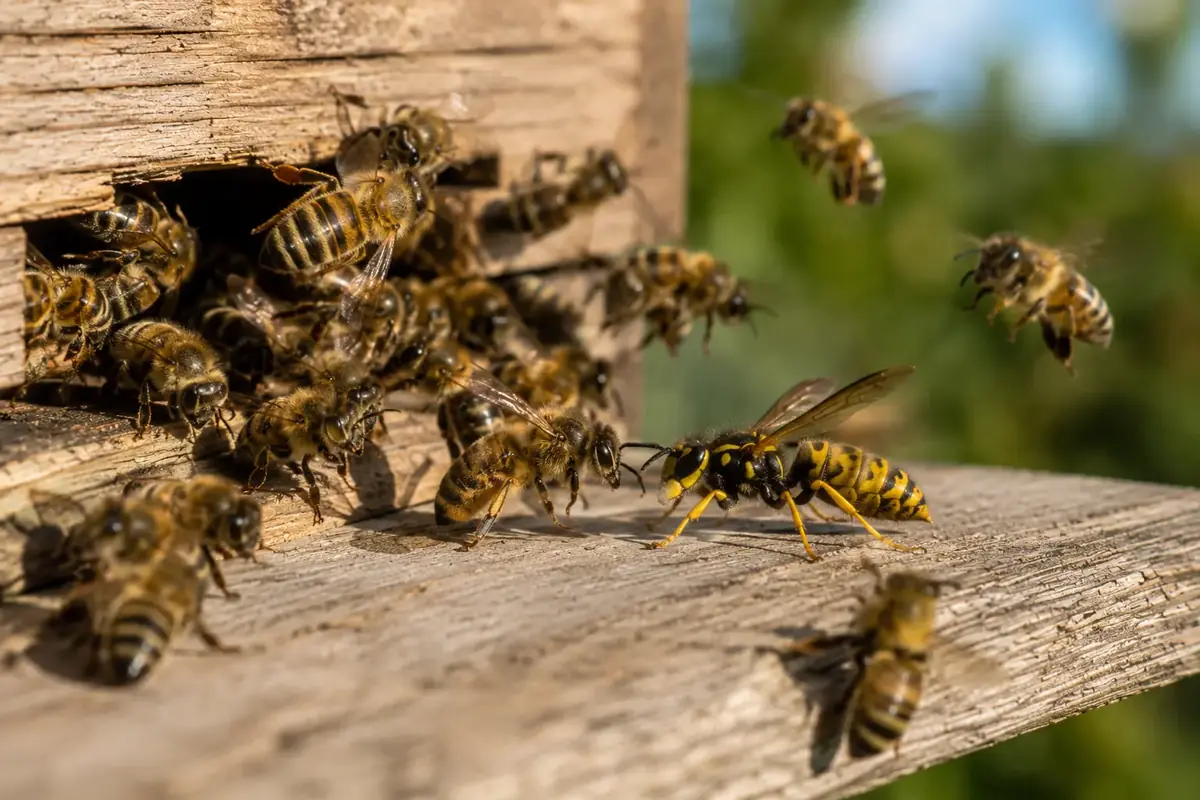
A Plett holiday house that's been quiet since Easter is exactly what a spring swarm is looking for: a dry wall cavity, nobody around, and months to build. By December, the bees have been there longer than you have.
When bees are using one gap in a wall, roof, deck or meter box at your Plettenberg Bay property, day after day, the bees have set up home. The colony needs removing along with its comb and the gap closed, or the problem simply repeats itself. The usual shortcut, killing the bees and walking away, leaves the comb behind, and in a Plett summer that comb melts, stains plaster and ceilings and pulls in the next swarm. A thick cluster of bees hanging off a branch or a fence is a resting swarm rather than a colony, and it's normally gone in a day or two.
We handle bee removals for homes, holiday houses, estates, guest houses, schools and businesses throughout Plettenberg Bay.
Why Plett homes attract bees
Plettenberg Bay sits between indigenous forest, fynbos-covered hills and river valleys, all of which support wild honey bee colonies. In spring and early summer, those colonies swarm, and the swarms look for dry, sheltered cavities. Plett's houses offer them plenty, and many of those houses are empty when the swarms are flying:
- Cavity walls with open weep holes or gaps in the mortar
- Roof spaces under tiles, especially on houses with wide eaves and complicated rooflines
- Under timber decks and stairs, where boards and cladding enclose a dry space
- Chimneys that won't see a fire until winter
- Water meter boxes and irrigation valve boxes in the garden
- Thatched roofs and lapas, where bees sometimes build into the thatch
Should you call us yet?
Bees clustered in a ball on a tree or a wall, not going into anything? Not yet. That's a swarm. It has no comb and is waiting to move on. Keep people away and give it a day or two, and if it hasn't left by then, our bee swarm guide explains the next step.
Steady traffic of bees through one small hole, all day? Yes. That's an established colony with comb inside, and it will keep growing.
Bees working in and out of the thatch of the lapa? Yes, and the sooner the better. Comb built into thatch gets harder to reach the bigger it grows.
The removal itself
A lot of removals in Plett are done for owners who aren't there, so we plan it with you or your caretaker beforehand. We find the entrance, work out where the comb really is (under a deck or in a complicated roof it's often well away from the hole), and explain what has to come off to reach it: deck boards, a few tiles, cladding or a panel of ceiling. On the day the area is cleared and we work suited up.
Moving a colony alive is possible when the comb can be reached and lifted out intact. When it's deep in a cavity, or very large and old, it usually isn't, and the colony is destroyed before the comb is taken out. You'll get a straight answer from us on which applies. The entrance is then sealed, or we write down exactly what your builder needs to close.
Holiday homes and the spring check
The single most useful thing a Plett holiday home owner can do about bees is have the house checked in spring, after swarm season starts and before the December rush. A small colony found in October is a much smaller job than a large one found by the family on arrival. Ask your caretaker to watch for bees going in and out of one spot, and include a bee check in a pre-season holiday home pest control visit.
Guest houses, schools and estates
A colony near a guest entrance, a pool, a playground or a restaurant terrace puts guests at risk, and anyone with a sting allergy most of all. We pick a quiet time, after hours or between check-outs, and cordon the spot off until we're done. On estates, colonies on common property are arranged through the estate manager or body corporate.
What to avoid
Spraying, hosing and blocking the hole all make things worse. Spray rarely reaches the comb. Water just enrages the colony. A blocked hole sends bees looking for another exit, which can be a downlight or an air vent indoors. And please don't lift deck boards or pull at thatch to look. If anyone is stung repeatedly, or a sting is followed by swelling of the face or throat or difficulty breathing, get them to medical help without delay.
Making the house bee-proof
Swarms look for a dry space with a small entrance, so the job is to leave them nothing suitable. Before spring, fit fine mesh inserts in weep holes and gable vents, cap the chimney, close gaps under roof tiles and behind fascia boards, seal the spaces behind deck cladding and around pipes, and make sure meter box and irrigation valve box lids fit. Where a colony has been removed, every bit of old comb must go, because the smell of a past colony is a strong draw for new swarms. Our honey bees profile explains why colonies swarm in the first place.
Price
Each job is quoted on its own. What we look at: where the comb is and how much of it there is, how high up, how much of the building has to be opened and how fiddly that is (thatch and decking on a slope take longer), and whether sealing is included. Meter box colonies are usually quick. A colony that has spent a few seasons in the roof of a big double-storey holiday house takes considerably more time.
There's more general information on our bee removal page, and pest control in Plettenberg Bay covers every other service in the area. For bees at a Plett home or guest house, call 044 012 5011 or describe the spot where the colony has settled. If you're away, give us your caretaker's number and we'll arrange it with them.
Frequently asked questions
Can you remove bees while we're not in Plett?
Yes. Your caretaker or agent lets us in, and we'll report back to you on what we found and what we did.
When should we have the holiday home checked for bees?
In spring, once swarms are on the move and well before you come down for December, while any colony that has moved in is still small.
Can bees live in a thatched roof?
They can. Getting a colony out of thatch takes care so the roof isn't damaged, and we'll explain how we'd go about it once we've seen where it is.
Can you work at a guest house without upsetting guests?
We'll time the work around your bookings where possible and keep guests clear of the area while we're busy.
How do we bee-proof a Plett house?
Fit fine mesh over roof vents and air bricks, seal gaps at the fascias and around pipes, and keep meter box lids and chimney caps in good repair. Get it done before spring.
There's a swarm resting on our deck. Is it dangerous?
A resting swarm is usually calm, but don't poke, spray or hose it. Keep people and pets well away until it moves on, and call us if it starts going into the house.