


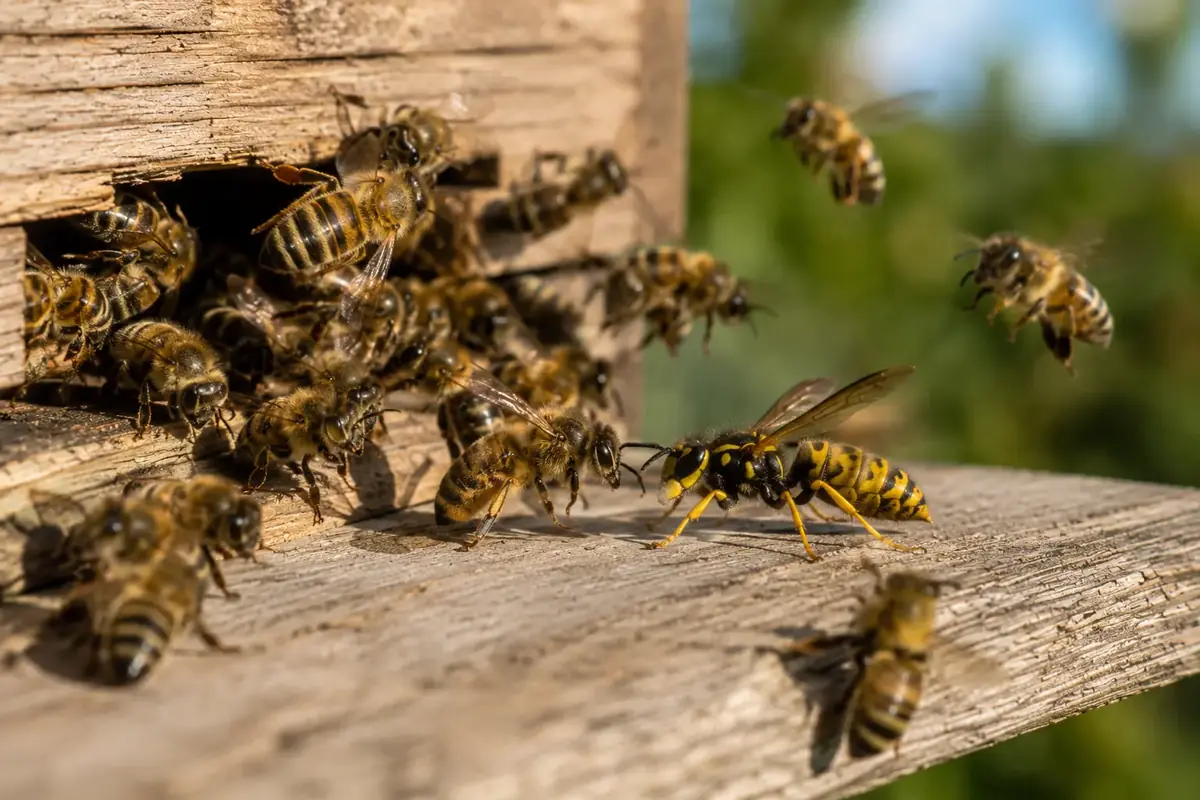
Forest on the hills, fynbos on the slopes and gardens in flower all year make Wilderness good bee country. Usually that's a blessing. When they move into the house, it isn't.
When bees have moved into a Wilderness house, the colony and every bit of its comb need to come out, and the gap they used must be closed afterwards. Comb left behind melts in summer heat, seeps honey through ceilings and walls, and its smell pulls the next swarm straight back to the same spot. If what you're looking at is a dangling clump of bees on a branch or gutter, rather than bees streaming in and out of a hole, that's a swarm resting on its way to somewhere else, and the best thing to do is keep everyone back and wait.
We remove bees from homes, guest houses, lodges, holiday cottages, schools and businesses in Wilderness and the surrounding hills.
What a season inside a wall looks like
A swarm that moves into a wall cavity in October starts with a few combs the size of your hand. By the end of summer, if nobody notices, there can be sheets of comb filling the cavity from top to bottom, heavy with honey and brood. That's the main reason to act early: a young colony is quicker to remove, needs less opening up and leaves less mess behind. If bees have started using a gap in your house this spring, don't wait to see whether they settle.
Where they get in
Wilderness houses offer bees plenty of dry, sheltered cavities:
- Wide eaves and complicated rooflines on hillside homes, with gaps where fascias meet the wall
- Timber cladding and gable ends, where a split board or a missing piece of trim opens a hollow space
- Under decks and timber stairs that are boxed in at the sides
- Chimneys on holiday cottages that sit cold for most of the year
- Roof spaces of guest houses and lodges, reached through a lifted tile or an open air vent
- Old trees along the river and in established gardens, with hollow trunks or branches
How we remove a colony
- Locate the comb We watch the entrance, then check from inside the room, the roof space or under the deck to find where the comb sits and how far it runs.
- Plan the opening We show you where we need to remove cladding, boards or ceiling to get to it, and keep it as small as the job allows.
- Take it all out The bees and all of the comb, honey and wax.
- Close the gap Once the cavity is clean, the entrance is sealed so another swarm can't use it.
Whether the colony can go to a beekeeper depends on where it is and how much comb we can reach. We'll tell you before we start.
Guest houses and lodges
Bees under the eaves of a guest room or around a breakfast terrace need dealing with quickly, but not in a way that turns a guest's morning into a spectacle. We plan removals for when rooms are empty or guests are out, close off the area while we work, and leave the room usable once we've packed up. If honey has stained a ceiling inside, we'll point it out so you can arrange the painter.
Walkers and swarms
Swarms often rest on fences, low branches or the side of a building for a night or two while scouts look for a home. They're usually calm, because they have no nest to defend, but they don't like being poked, hosed or sprayed. If a swarm settles near a path, a guest entrance or a play area, keep people back and call us if it hasn't moved on after a day or two, or if it starts going into a building. There's more in our bee swarm guide.
Please don't
- Spray insecticide into the entrance. The bees die slowly inside, the comb stays, and the smell draws the next swarm
- Seal the hole with bees still inside. They'll find another way out, sometimes into a bedroom
- Light a fire under a colony in a chimney, which can drive bees into the house and set wax alight
Stings
A single sting is painful but passes for most people. Flick the sting out sideways with a fingernail or a bank card; pinching it squeezes in more venom. If someone is allergic, has swelling around the face or throat, struggles to breathe, or has been stung many times, get medical help at once.
What it costs
Where the colony sits, how large it has grown, how much has to be opened and closed again, and how high or awkward it is to reach: that's what sets the price. A colony in a meter box or a low wall is a short job. One that has filled the gable end of a double-storey lodge takes most of a day. We'll quote after we've seen it.
For background on the bees themselves, see our honey bee profile and the main bee removal page. Our Wilderness page, pest control in Wilderness, covers every other service. Call 044 012 5011 or tell us where the bees are going in.
Frequently asked questions
How quickly should I deal with bees in my wall?
As soon as you see them using a gap in the house. A young colony is smaller, quicker to remove and leaves less mess than one that has filled the cavity over a summer.
Can you get bees out from behind a gable end?
Yes. We locate the comb, open the cladding or boards needed to reach it, remove everything and seal the gap.
There's a swarm on the fence by the guest entrance. What do we do?
Keep guests away and give it a day; swarms often move on by themselves. Call us if it's still there after that, or if it starts going into a building.
Can you remove bees while the lodge is open?
Yes. We work when rooms are empty or guests are out and close off the area until we're finished.
Will honey stain the ceiling?
It can, if the colony has been there a while. Once we've removed the comb, any staining inside is a job for your painter.
How do I take out a bee sting?
Get it out fast by flicking it sideways with a fingernail or a card, then wash the spot and hold something cold on it.