


You walk outside and there's a humming brown ball of bees hanging from the lemon tree. Before anyone reaches for the hosepipe, here's what's actually going on and how to handle the next day or two.
Leave it alone, keep children and dogs indoors or well back, and watch from a distance. A swarm hanging in the open is a colony between homes. The bees have no comb, no honey and no brood to protect, so they're as calm as bees ever get, and most swarms lift off and fly away within a day or two. What you want to avoid is the moment it stops being a swarm and becomes a colony living in your roof.
What a swarm actually is
A healthy colony that has outgrown its cavity splits in two: the old queen leaves with a large share of the workers to start again somewhere else. They pour out of the hive, fly around in a noisy cloud, and settle in a cluster close by while scout bees search for a new cavity. The cluster can be the size of a fist or bigger than a soccer ball. It might be on a branch, a fence post, a gate, under a bench, on a wing mirror, anywhere.
Before leaving, the bees gorge on honey. A full bee with nothing to defend has little reason to sting, which is why beekeepers can handle swarms with bare hands. That doesn't make it safe to poke one. It means a swarm left in peace is low risk.
The first hour
- Get people and pets out of the way, and close nearby windows and doors so stray bees don't wander in
- Don't spray it, hose it, throw things at it, light a fire under it or try to knock it into a box. Every one of those turns calm bees into defensive ones
- If it's near a front door, a gate, a school entrance or a shop, put up a simple barrier or sign and use another way in for the day
- Take a photo from a safe distance. If you call us or a beekeeper, it tells us a lot
The next day or two
Keep an eye on it, from a distance, a few times a day. Three things can happen.
It leaves. One morning the cluster is gone. The scouts found somewhere and the swarm moved. Nothing more to do, except maybe ask yourself whether "somewhere" was in your street.
It stays put in the open. Occasionally a swarm can't find a home and starts building comb right where it hangs, under a branch or an eave. Once you see pale wax sheets forming, it's become an open-air colony and needs dealing with.
It moves into your building. This is the one to watch for. Instead of one cluster, you'll see bees streaming in and out of a single gap: under a roof tile, through a fascia board, into a gable vent, a chimney, a water meter box or the hollow of a wall. They've moved in. From here they build comb fast, the colony grows, and it won't leave on its own.
When to call someone
A swarm in the open, in a quiet garden, usually needs nobody. If it's somewhere that can't wait, a gate the children walk through or a busy shopfront, a local beekeeper may be glad to collect it. It's free bees for them, and it's the best outcome for the swarm.
Call us when the bees have moved into the building, when there's comb in the open, when someone in the household is allergic to stings, or when the bees are behaving defensively: chasing people, bumping into heads, stinging without being touched. Our bee removal page explains how an established colony is taken out, comb and all, and the entrance closed so the next swarm can't follow.
Why getting them out early matters
A colony that's been in a roof for a week has a few sheets of new comb. One that's been there through a summer has a large block of wax and honey, heavy and sticky, and getting it out properly means opening up more. Comb left behind melts in the heat, stains ceilings, smells, and draws the next swarm to the same spot. So if you saw the swarm go into the eaves, don't wait to see what happens.
Stings: what to do
Stings around a swarm usually follow someone getting too close or trying to move it.
- Walk away briskly, in a straight line, to a house or car. Don't stand flapping your arms
- Get the sting out quickly. Drag a thumbnail or the edge of a card across the skin to lift it, rather than pinching, which squeezes the venom sac
- Rinse with water and put an ice pack, wrapped in a cloth, on the swelling
- Look out for a puffy face or tongue, a tight throat, wheezing, feeling faint, or hives breaking out away from the sting. Treat any of those as an emergency and get to a doctor or call for help at once
- Someone who has been stung many times needs medical attention even if they feel fine at first
If anyone in the family has reacted badly to a sting before, keep them indoors until the bees have gone.
Is it bees at all?
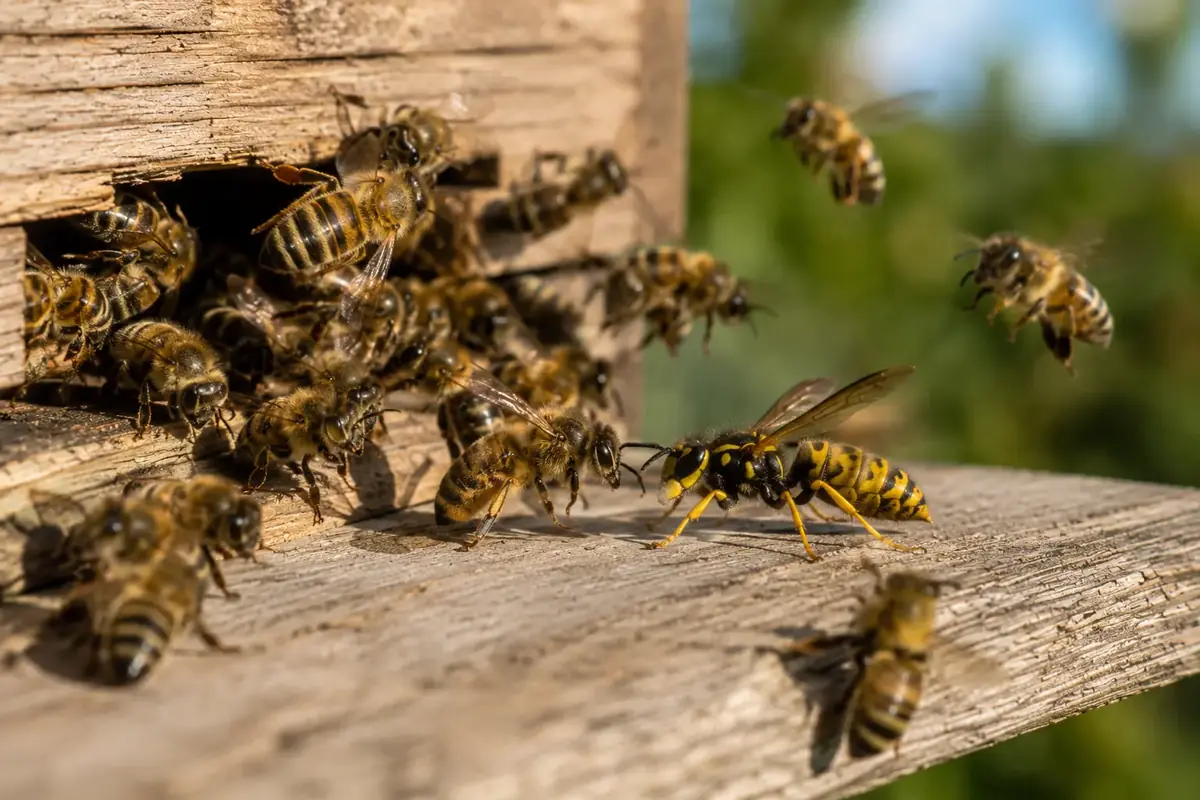
Now and then a "swarm" turns out to be wasps around a grey paper nest under the eaves. Bees are fuzzy and golden brown, and they cluster or live in cavities. Wasps are smooth, narrow-waisted and build their own nests in the open. Wasps are a different job, covered on wasp removal. Our honey bee profile explains more about how bees choose a home.
Making your house less attractive
Scout bees are looking for a dry, dark, sheltered hollow with a small entrance. You can't stop swarms passing through, but you can make sure your house has nothing to offer them:
- Fit fine mesh behind gable vents and over air bricks that open into a roof space
- Fix loose fascia boards and the gaps where the roof meets the wall
- Cap chimneys you don't use
- Keep water meter boxes, irrigation boxes and compost bins properly closed
- If you've had bees before, check the old entrance each year in late winter
In your town
Each of these towns has its own page, with the local houses and the spots bees favour there: Oudtshoorn, Wilderness, Mossel Bay, Plett, Knysna and George.
If the bees have moved in, or you're not sure, ring 044 012 5011 and send a photo of the cluster or the entrance through our contact page. We'll tell you honestly whether it's a job for us, for a beekeeper, or for nobody at all.
Frequently asked questions
How long will a bee swarm stay in my garden?
Usually a day or two, sometimes only a few hours. Once the scouts agree on a new home, the whole cluster takes off together. If it's still there after a few days and you can see wax forming, it has decided to stay.
Is a bee swarm dangerous?
Not if it's left alone. Swarming bees have no home to defend and are full of honey, so they're usually calm. Disturbing the cluster changes that quickly, so keep people and pets away.
Can I spray the swarm with insecticide?
Please don't. It's unlikely to kill the whole cluster, it makes the survivors defensive, and the dead and dying bees end up all over your garden. Waiting is safer and usually all that's needed.
Will a beekeeper collect the swarm?
Many local beekeepers are happy to collect a swarm hanging in the open, because it's a free colony for them. Once bees are inside a wall or roof, it's a removal job rather than a collection.
The bees moved into our eaves. Will they leave in winter?
No. A colony that has built comb inside your roof stays for good and grows each season. It needs to be removed, comb included, and the entrance closed.
My child was stung. When should I worry?
Get the sting out first, then keep an eye on them for the next half hour. Local swelling and pain are normal. Trouble breathing, a swollen face, or hives spreading over the body are not, and need a doctor straight away.