


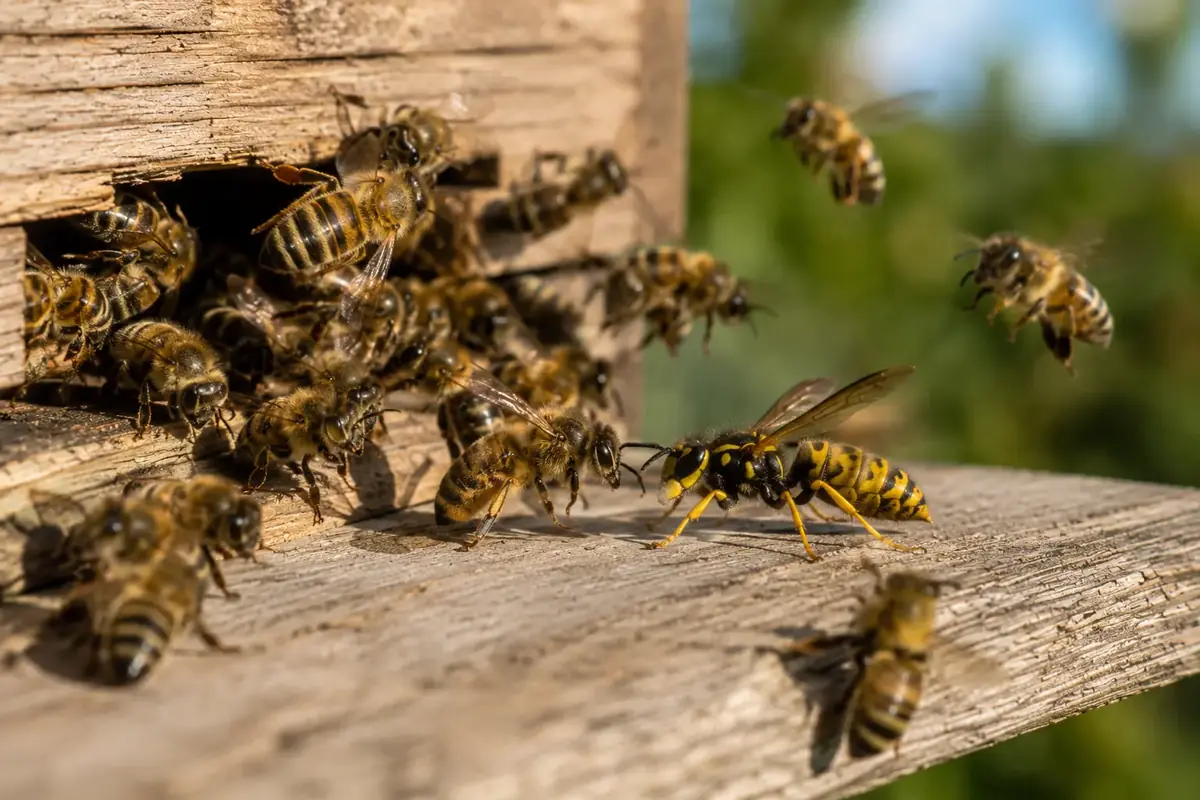
The forest around Knysna is full of wild bees, and in spring their swarms go house-hunting. Timber cladding, deep eaves, hollow trees and quiet holiday homes give them plenty of choice.
Bees that have settled into a wall, roof space, deck, chimney or meter box at a Knysna house have to come out together with their comb, and the opening they used has to be closed, or another swarm will move into the same place within a season or two. Many Knysna houses are clad or framed in timber, which means the comb is often hidden behind boards some way from where the bees go in. That is the main thing that makes bee work here different. A dense cluster resting on a branch or a fence post, on the other hand, is only passing through, and it usually leaves on its own within a day or two.
We take out bee colonies at homes, holiday houses, guest houses, schools and businesses in Knysna and on the forest edges around it.
Why Knysna houses suit bees
Knysna is ringed by indigenous forest and fynbos, which support a large wild honey bee population. Every spring and early summer, strong colonies split, and swarms go looking for a dry, sheltered cavity of the right size. Knysna's houses offer plenty:
- Timber-clad and timber-framed walls, where a gap at a joint or around a window gives access to a hollow space behind the cladding
- Roof spaces reached through gaps at the eaves, under tiles or around flashing
- Chimneys that sit unused through summer
- Under decks and stairs on hillside homes, where boards enclose a sheltered space
- Water meter boxes and compost bins
- Empty holiday homes, where nobody notices a colony settling in until it's large
Passing through, or moved in?
The difference matters, because one needs nothing from us and the other does. A swarm is out in the open with no comb at all: a beard of bees on a branch, a deck rail or a car's side mirror. It's waiting for its scouts and is usually calm. Leave it be, keep the dog inside, and read our guide to handling a bee swarm if it has landed somewhere awkward.
Moved-in bees use one fixed doorway. Watch it for five minutes and you'll see a steady flow of foragers, some coming back with pollen packed on their legs, and a few bees standing guard or fanning at the entrance. Behind that doorway there's comb, honey and brood, and the colony will defend it.
Getting to comb behind timber
- Trace it The entrance might be a gap at the bottom of a cladding board, while the comb is a metre or more up inside the wall, or across a rafter in the roof. We find where it really is before anything gets opened.
- Agree on the opening A few cladding boards off, some tiles lifted, a hatch cut in a ceiling board or deck planks lifted: you'll know exactly which before we start, and boards are taken off carefully so they can be refitted.
- Take it out Some colonies can be lifted out with their comb and given a new home, and some can't, depending on their size and how cleanly the comb comes away from the timber. We'll tell you which we think it is. A colony that can't be saved is destroyed before the comb is removed.
- Clean up and close Every bit of comb, and as much honey residue as we can get at, comes out, because wax and honey soaked into timber attract the next swarm. Then the gap is sealed, or we give your carpenter a clear list.
Holiday homes
A house that's empty from autumn to December gives a swarm months to settle in and build. By the time the family arrives, there's a large colony in the wall next to the braai. If you have a holiday home in Knysna, a check in spring, or asking whoever looks after the house to watch for bees flying in and out of one spot, catches it early. Our holiday home pest control visit includes it.
Please don't
- Spray a can of insecticide into the gap. Bees behind cladding are well protected, and you'll only stir them up
- Close the gap while they're inside. A timber house has plenty of other ways out, and some of them lead indoors
- Prise off cladding yourself with bees active behind it
Anyone with a swollen face or throat, wheezing or dizziness after a sting, or with a large number of stings, needs medical help straight away. First aid basics are on our honey bees page.
Before next spring
Late winter is the time to look. Walk around the house and check where cladding has shrunk away from window frames, the gaps at the ends of fascia boards, gable vents without mesh, the chimney cap, holes where old cables or pipes once went through, and every meter box lid. A colony that has been removed leaves a scent that new swarms recognise, so if you've had bees before, that old site is the first place to check and seal.
Bees near the lagoon and in the forest
Houses on the forest edge, around the lagoon and up in the hills see more swarms than those in the middle of town, simply because they're closer to the wild colonies. If you live on the edge of the forest, a quick walk around the house each spring is worth the ten minutes it takes.
What decides the price
We quote once we've seen where the bees are. A small colony in a meter box at ground level is a short, simple job. A big, established colony behind the cladding of a double-storey house on a Knysna hillside, needing a long ladder or scaffolding to reach, is several times the work. What makes the difference is the size and position of the comb, the height, how much timber or roofing has to come off and go back, and whether sealing is part of it.
More detail is on our bee removal page, and for anything else, see pest control in Knysna. Bees moving into your Knysna wall or roof? Phone 044 012 5011, or tell us where they are. If it's safe to get close enough, a photo of the entrance is a big help.
Frequently asked questions
Can you get bees out from behind timber cladding?
Yes. We find the comb, lift the boards needed to reach it, take out the colony and all of the comb, then close the entrance. We'll show you which boards have to come off before we start.
We can hear buzzing in a wall but can't see an entrance. Is it bees?
Possibly. Watch the outside of that wall on a warm morning: a colony shows up as a steady stream of bees through one small gap, often at a cladding joint or under the eaves. Tell us where it is and we'll check.
Can you look over our holiday home for bees before we arrive?
Yes. A spring check of an empty house picks up colonies while they're small, which makes the removal quicker and the clean-up smaller.
How do we stop bees moving back into the cladding?
Seal gaps at cladding joints, fascias, vents and chimneys before spring, and make sure the old comb went. The smell of old comb is what draws new swarms back.
There's a swarm in a tree near the lagoon path. Should we call?
A swarm hanging in the open usually moves on within a day or two, so just keep people away. Call us if the bees start going into a gap in a building.
Can honey in the wall damage the house?
It can. Wax and honey left in a wall or ceiling soften in summer heat and can seep through, which is why we take the comb out instead of only dealing with the bees.