


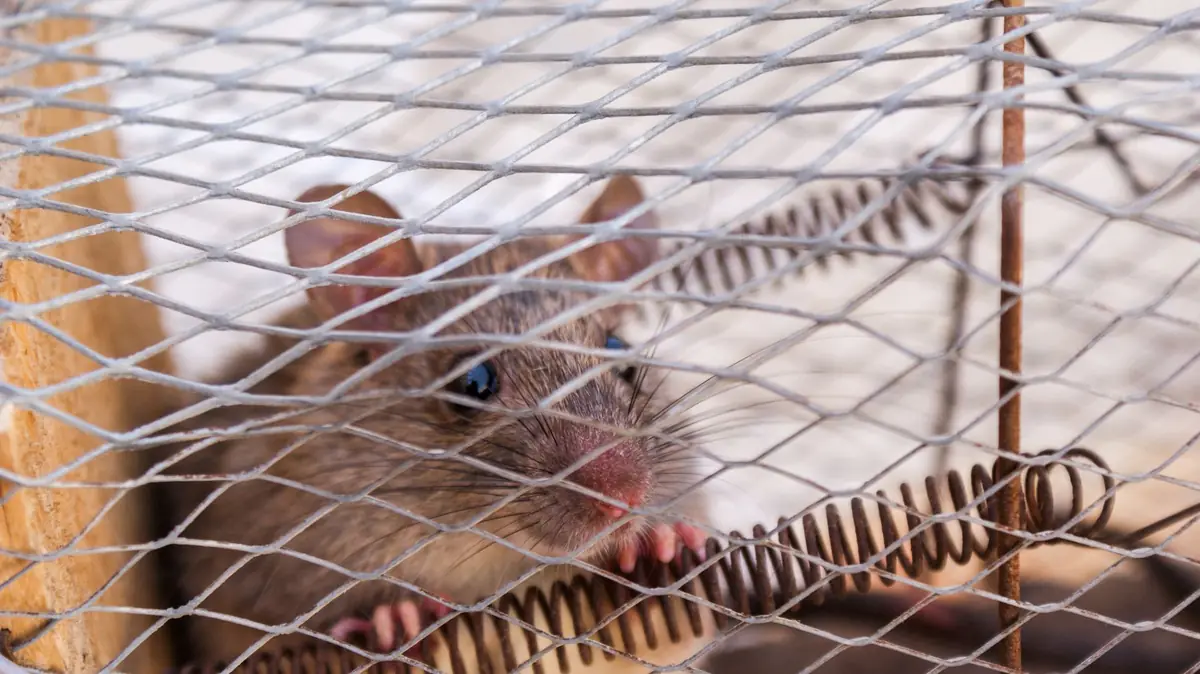
You haven't actually seen it, but something is in the pantry, and you'd like to know what before you buy a trap. The evidence it leaves behind is usually enough.
Look at the droppings first. Mouse droppings are a few millimetres long, thin, and scattered around in large numbers wherever the mouse has been. Rat droppings are a centimetre or more, as thick as a pencil lead or thicker, and tend to be found in fewer, bigger clusters along the routes the rat uses. If what you're finding would fit on your little fingernail several at a time, it's mice. If one dropping covers the nail, it's a rat.
Most of the time that answers the question. When it doesn't, the clues below will.
Clue 1: droppings, close up
Put on gloves, take a ruler and look carefully.
- Mice: 3 to 6 mm, thin, with pointed ends. Dozens at a time, scattered in drawers, along the back of shelves and behind the stove, because mice drop them as they go
- Roof rats: roughly 1 to 1.5 cm, slim and curved, with pointed ends. Often concentrated on top of a wall in the roof, on a beam or behind an appliance
- Brown rats: chunkier, up to about 2 cm, with blunt ends. Usually low down: the garage, under a deck, near a drain
Fresh droppings are dark and slightly shiny. Old ones are dull, grey and crumble when touched. If you clean them all up and find new ones in a day or two, you know the activity is current.
Clue 2: the noise
Lie in bed and listen. Mice sound light and fast: a pitter-patter, a scratch, then silence. Rats are heavier. You hear thumps, a scurry that clearly has weight behind it, and sometimes a dragging or rolling sound as a rat moves a piece of food, an avocado pip or a lemon across the ceiling boards. Steady gnawing from one spot, a rasping scrape that goes on for minutes, is more often a rat.
Both are mainly active at night, so noise doesn't help in the daytime.
Clue 3: footprints
This is the easiest test and it costs nothing. Sprinkle a thin, even layer of flour or talcum powder on a hard floor along the skirting, or on a sheet of cardboard, where you think the animal travels. Check it first thing in the morning.
- Mouse prints are tiny, about a centimetre across, often with a thin line in the middle from the tail
- Rat prints are about twice that size, with clearly separated toes, and a heavier tail drag
It also shows you the route, which tells you exactly where a trap should go.
Clue 4: gnawing and holes
Mice nibble. A mouse leaves fine scratches, small neat holes in packaging, the corners chewed off soap and nibbled edges on cardboard boxes. Holes it makes in skirting boards or ceiling boards are about the size of a ten-cent piece.
Rats gnaw. The tooth marks are deeper and coarser, holes have ragged edges and can be big enough to fit a golf ball through, and they'll chew through harder things: plastic pipes, water fittings, the lids of bins, cable insulation.
Clue 5: what's been eaten
Mice graze. They take a little from many places: a hole in the cereal box, a nibble at the bread, a bit of the dog's pellets. Rats take more in one go, and they carry it off. A whole avocado or guava hollowed out on the tree, fruit missing from the bowl overnight, or a pile of pips and husks in the roof all point to rats.
Clue 6: if you do see one
A brief look at something running across the kitchen can mislead, because a young rat is about the size of an adult mouse. Check the proportions. A young rat has a big head and big feet for its body, and a thick tail. A mouse has a small, pointed head, large ears and small, delicate feet. Our house mice and roof rats profiles have full descriptions.
Why it matters
The treatment follows the animal.
- Traps. A mouse trap won't hold a rat. It just hurts it and makes it trap-shy. Rat traps are much larger and stronger
- How they react to traps. Mice are curious and investigate anything new, so a trap set tonight may catch one tonight. Rats are suspicious of new things in their territory. Leaving a rat trap baited but unset for a few nights, until the rat is used to it, makes a real difference
- Where to look. Mice live close to food, inside the house. Roof rats live up high and come down to eat. Brown rats live low, outside, and come in from below
- Proofing. A mouse can wriggle through a slot no thicker than a pencil. A rat needs a bit more room, but can gnaw a small gap wider. Brush strips under doors stop mice; rats need gaps at the eaves, roofline and around pipes closed with something they can't chew
Cleaning up droppings safely
Rodent droppings and urine can carry disease. Don't sweep or vacuum them dry, because that puts dust into the air. Wear gloves, spray the area with a household disinfectant, leave it a few minutes, then wipe up with paper towel and bin it in a sealed bag. Wash your hands afterwards, even with gloves.
When to call us
One or two mice can often be handled with traps. If you're finding droppings in several rooms, hearing activity every night, or you've decided it's rats in the roof, it's time for a proper treatment. Our rodent control page explains what that involves, and rats in the roof in autumn covers the seasonal side.
Still not sure? Photograph the droppings beside a coin and send it to us, or call 044 012 5011. That's often all it takes to tell.
Frequently asked questions
Can rats and mice live in the same house?
Yes, it happens. The droppings, footprints and noises usually show whether you have one or both, and both can be treated on the same visit.
Is it a baby rat or a mouse?
Look at the head and feet. A young rat has an oversized head and big feet for its body, and a thick tail. A mouse has a small pointed head, large ears and dainty feet.
Will a mouse trap kill a rat?
Usually not. It tends to injure the rat and make it wary of traps. Use a proper rat trap, or bait stations, for rats.
The rat won't go near my trap. Why?
Rats avoid new objects in their territory. Put the trap out baited but not set for a few nights, then set it once the bait is being taken.
Does the flour test work on carpet?
Not well. Use a hard floor, or lay a flat piece of cardboard or a baking tray with a thin dusting of flour where you think the animal runs.
Is it safe to sweep up mouse droppings?
Avoid sweeping or vacuuming them dry. Wear gloves, wet them with disinfectant first, then wipe them up and bin them in a sealed bag.