


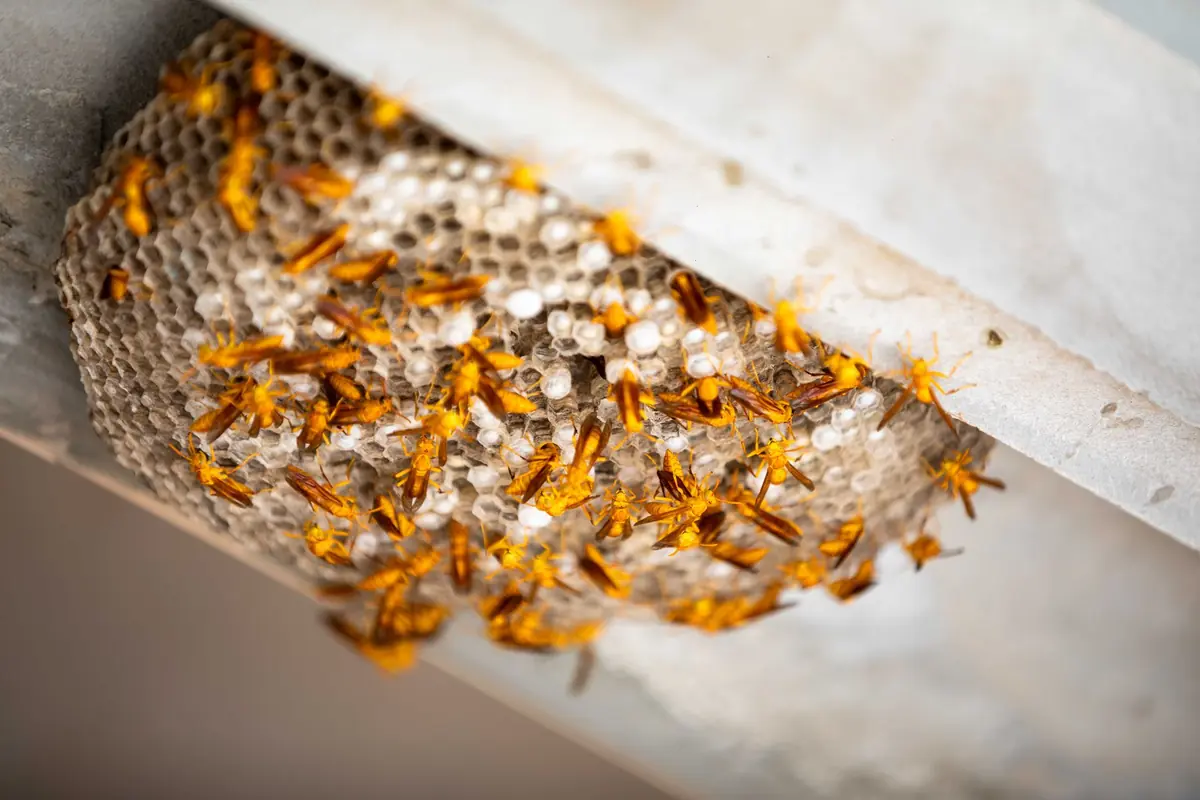
Picture the first braai of the holidays. Everyone on the deck, a cold drink, the view over the bay, and a cloud of paper wasps above the table from the nest that's been growing under the eaves since September.
Paper wasp nests at Plettenberg Bay homes are best removed in spring, while they're small, and certainly before the holiday crowds arrive. A nest that starts in September with a single wasp can have dozens of wasps defending it by December, right above the deck, the outdoor shower or the front door. We treat the nests when the wasps are home, take them down so the larvae don't attract other insects, and walk the whole house so we find all of them, not just the one you've seen.
We remove wasp nests at holiday homes, permanent homes, estates, guest houses, restaurants and schools across Plettenberg Bay.
Why wasps like Plett houses
Paper wasps build their grey, papery nests in sheltered spots out of the rain: under eaves, in the corners of gutters, in pergolas and lapas, behind shutters and under outdoor furniture. Plett's houses, with their wide eaves, big decks, timber pergolas, outdoor showers and braai areas, offer plenty of those spots. And because many houses are empty from Easter to December, the wasps build undisturbed for months. Nobody walks under the eaves, nobody notices the nest, and by the time the family arrives, it's at its biggest.
Where to look
- Under the eaves on every side of the house, especially sheltered corners
- Inside pergolas, lapas and carports
- Under the roof of an outdoor shower
- Under deck boards and stairs
- Behind shutters and in window frames
- Inside meter boxes and irrigation valve boxes
- Under garden furniture, sun loungers and umbrellas left out
- In hedges and dense coastal shrubs near the house
How a nest grows
A nest starts in spring with one mated female, working alone. She builds a handful of cells, lays an egg in each and raises the first workers herself, and for those weeks the nest is no bigger than a coin. Once the workers hatch they take over the building, and from then on it grows quickly. By the end of summer it can cover your palm, with a crowd of wasps on it. So a check in October or November, before the house fills up with children, does more to prevent stings than anything else.
How we remove nests
- Search the property One visible nest usually means others nearby. We look under every eave, in each pergola and outbuilding, under the decks and in the hedges.
- Pick the moment Nests are treated in the early morning or evening, when the wasps are home.
- Take them down Dead nests come down so they don't attract ants and scavengers.
- Leave a map We show you, or your caretaker, the spots wasps keep coming back to, so they get checked each spring.
Before the holidays
If you're coming down for December, book a pre-season visit in October or November. We'll remove any nests and check for whatever else has settled in during the quiet months. It's part of our holiday home pest control service, and you don't need to be there.
Restaurants, guest houses and the beachfront
Wasps go where people eat outside, and in Plett that's everywhere in summer: restaurant decks, beachfront terraces, guest house breakfast patios and pool areas. German wasps, an invasive species, are particularly drawn to meat and sweet drinks. A spring check of eaves, umbrellas, pergolas and outdoor furniture, plus closed bins and quick clearing of plates, keeps them away from guests. See commercial pest control.
Wasp or bee?
Wasps are sleek and shiny, with a thin waist, and their papery nests hang in the open. Bees are hairy and work out of a hidden cavity through a single entrance. They're handled completely differently: see bee removal in Plettenberg Bay. Our wasps profile explains the different kinds of wasp you'll see.
Don't try this
A broom against a big nest, especially when you're on a ladder, ends badly more often than not. So does a hose at close range. On a house with thatch or a lot of exposed timber, burning a nest is out of the question. If the nest is tiny, close to the ground and it's early spring, you can knock it down in the cool of the morning. For anything else, call us.
If someone is stung
Walk away from the nest, rinse the sting and cool it. Children, anyone with a known allergy and anyone stung several times need watching: swelling of the face or throat, trouble breathing or dizziness means medical help straight away.
Wasps and thatch
Thatched roofs and lapas deserve special care. Wasps build into the underside of the thatch and between the poles, and the usual tricks of reaching a nest are limited by the material. We treat nests in thatch carefully, without open flames or anything that could damage the roof, and remove what can be reached.
What it costs
Nests are priced on how many there are, how high up, and how well hidden, whether in a thatched lapa, under decking or in a cavity. A few nests under single-storey eaves take little time. A double-storey roofline or a thatched roof takes more.
More on wasps in general is under wasp nest removal, and our other Plett services under pest control in Plettenberg Bay. To book, phone 044 012 5011 or send us a note about where the nests are.
Frequently asked questions
When should I have wasp nests removed in Plett?
In spring, while they're small. If you're coming down for December, book a check in October or November.
Do you need me to be there?
No. Your caretaker or letting agent can open up, and you'll hear from us what was found and removed.
Is it safe to burn a wasp nest?
No. Burning a nest under eaves, especially on a timber or thatched house, is a serious fire risk.
Can you remove wasps from a restaurant deck?
Yes. We treat and remove nests at restaurants and guest houses, ideally before customers arrive or after closing.
Can wasps nest in thatch?
Paper wasps sometimes build on the poles and under the edge of a thatched roof or lapa. Keep fire and smoke well away from thatch and let us take the nest down.
Why was there a huge nest waiting when we arrived in December?
The house was quiet for months, so nothing disturbed the queen when she started building in spring. A check in October catches nests while they're still small.