

The best time to sort out insects in a Plettenberg Bay holiday home is a few weeks before anyone arrives, not on the first morning of the holiday. A proper inspection and a residual barrier treatment done ahead of the season deals with whatever moved in while the house was empty, and keeps protecting it while it's full. If you live in Plett all year, the same approach works whenever the problem shows up.
What a quiet house invites in
Plett runs at two speeds. For most of the year a lot of homes and estates are locked up, with a gardener or caretaker popping in now and then. Then December arrives and the same houses are packed with family, guests, food and braais. Insects take advantage of both halves.
In the quiet months nobody disturbs the corners. Spiders build up in eaves and garages, fishmoths work through stored linen and boxes of books, and ants find the one forgotten packet of sugar. The moment the house fills with people and food, cockroaches and ants have everything they need, and a problem that took months to build shows itself in a weekend.
The usual suspects in Plett
- Fleas are the classic holiday-home surprise. Flea pupae can lie dormant in carpets and rugs for a long time, and the warmth and vibration of people walking around is what triggers them to hatch. The family arrives, and within a day everyone's ankles are bitten.
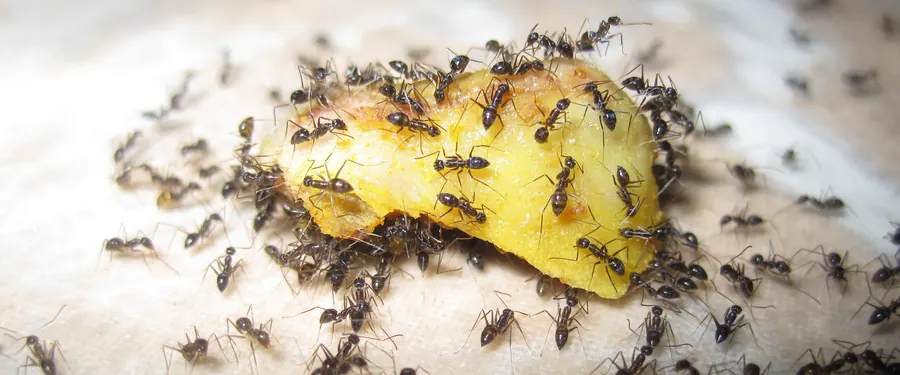
- Ants trail in from the garden, especially where lawns and flower beds run right up to the walls.
- Cockroaches in kitchens, sculleries and the back of rental units where bins sit between guests.
- Fishmoths and pantry pests in cupboards that have been shut for months with linen, paper or old dry goods inside.
- Flies around bins, outdoor kitchens and braai areas once the season is in full swing.
How we treat a Plett property
We start with a walk-through, inside and out. In an empty house that means opening the rooms nobody has used, checking under beds and in linen cupboards, and looking at where the garden meets the walls. In an occupied home or a lodge, we ask what people have been seeing and where, because the pattern tells us where the insects are living.
Then we treat the cause. Usually that's an odourless, non-staining residual spray as a protective barrier around the outside of the house and along the routes insects use inside, gel baits for cockroaches in the kitchen, and ant baits that the workers carry back to the nest so the whole colony dies, not just the trail. Fleas need carpets, rugs and pet areas treated thoroughly.
You don't need to empty the cupboards or move out. Once the treatment is dry it's safe for children and pets, so if you're already on holiday, carry on with your day.
Lodges, rentals and restaurants
Hospitality in Plett depends on the summer. A guest who sees a cockroach in a self-catering kitchen or gets bitten in a rental doesn't forget it, and they tend to say so online. For guest houses, rental agents and restaurant kitchens we can set up a regular service, with treatments before the rush and at set points through the year, worked around check-ins and trading hours. Commercial kitchens in particular do far better on a schedule than waiting for a sighting.
A local tip worth doing
If your house stands empty for most of the year, ask whoever looks after it to vacuum the carpets and rugs a week or two before you arrive, and to empty the vacuum outside. It disturbs dormant fleas, pulls eggs out of the fibres and helps our flea treatment work faster. And clear out the pantry at the end of every season. A half-used bag of flour from last December is where most pantry moth problems in holiday homes begin.
The mistake we see every summer
Setting off a supermarket fogger the night before guests arrive. It fills the room with spray, misses the cracks where cockroaches actually hide and doesn't reach flea pupae deep in the carpet. It can even push cockroaches further into walls and cupboards. It feels like you've done something, but it's rarely the end of it.
How much will it cost?
It depends on the size of the property and garden, which insects we're dealing with, and how long they've had to settle in. A routine pre-season barrier treatment on a family home is a straightforward job. A large estate home, a block of rental units or a busy restaurant kitchen takes longer and usually works best on a contract with scheduled visits. Heavy cockroach or flea problems can need a follow-up. We quote free once we've seen the place. If you've only got a few ants on one counter, wiping the trail with soapy water and putting the food away may genuinely be enough, and we'll say so.
Our insect treatments come with a 3-month guarantee, which comfortably covers a full holiday season. We're SAPCA registered and have worked across the Garden Route for more than 25 years. If you're seeing rats as well, have a look at rodent control in Plettenberg Bay, or read more about how we handle insects across the region.
Call us on 044 012 5011 to book a treatment before the season, or WhatsApp us a photo of what you've found and we'll tell you what it is.
Questions we get asked
When should I book a pre-season treatment in Plett?
A few weeks before you or your guests arrive is ideal. That gives the treatment time to work on anything already in the house and leaves the barrier fresh for the busy weeks.
Do I need to be at the house for the treatment?
No, as long as someone can let us in and point out the problem areas. Many owners arrange access through a caretaker or rental agent, and we report back on what we found.
Why are there fleas when nobody in the house has a pet?
Fleas can be left behind by a previous tenant's dog or brought in by animals visiting the garden, and the pupae can wait in carpets for months. People moving around the house is what wakes them up.
Can you treat a restaurant without closing it?
Usually, yes. We plan commercial treatments around trading hours, and gel baits and residual sprays are applied so the kitchen can keep running safely.
What if the insects come back in the middle of the holidays?
Let us know. If the insects we treated for return within three months, we come back and re-treat at no extra cost.