


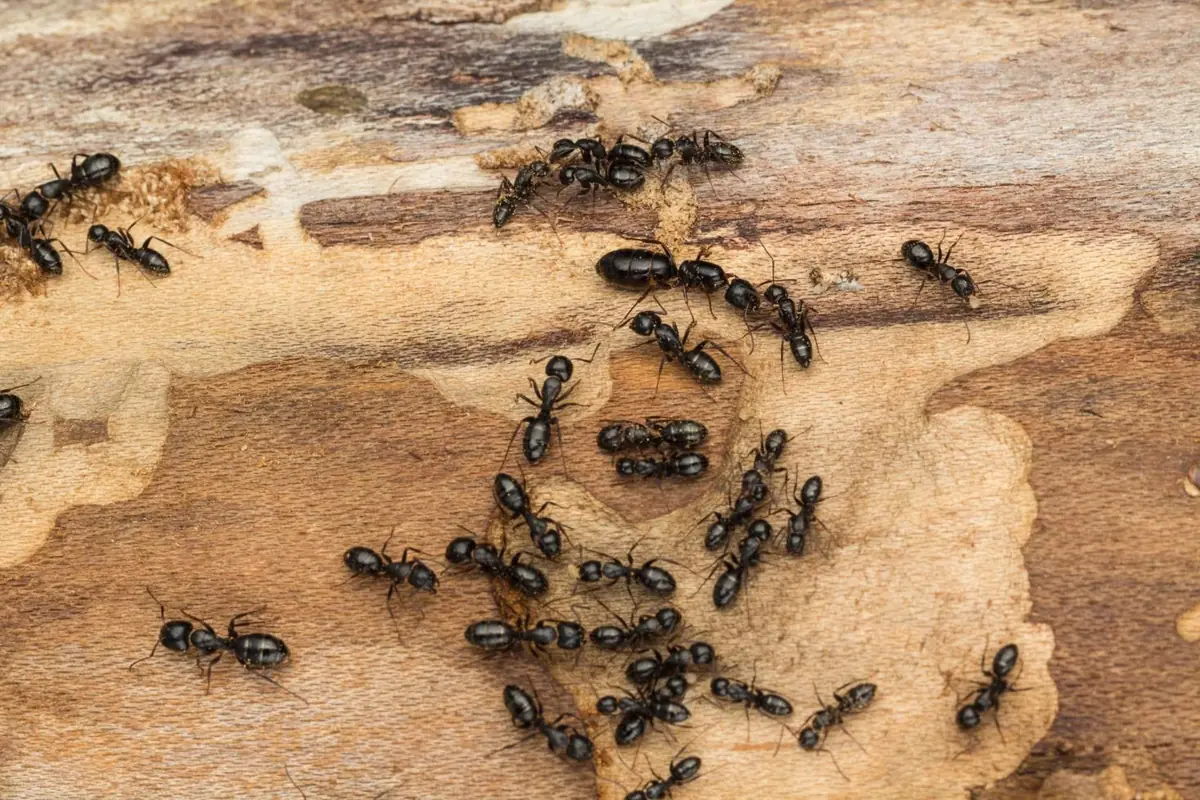
In a town built on sand, ants have endless places to nest. The trick is to get the bait to the nest, rather than fight the ants on your kitchen counter.
Ants in a Sedgefield house are best dealt with by baiting the trails so the workers carry a slow-acting bait home to the nest, treating the sand joints and edges where they nest under paving and decks, and closing the gaps they use to get indoors. Spraying the ants you can see feels productive but only thins out the workers, and the nest replaces them within days, sometimes splitting into several new nests as it does.
From holiday cottages to guest houses and the shops and restaurants in town, we deal with ants all over Sedgefield and along this stretch of coast.
Ants and sand
Sedgefield gardens are sand under a thin layer of lawn and beds, and paving here is mostly laid on a sand bed. That suits ants perfectly. Nests go in under pavers, along the edges of paths and driveways, beneath timber decks, in raised beds and in pot plants on the stoep. You'll see the signs before you see the nest: little heaps of fine sand pushed up between the bricks, a paver that has started to rock, a line of ants disappearing under the deck.
Spraying the surface of the paving does very little, because the colony is in the sand bed underneath. Treating the joints and edges, and baiting the trails that lead from them, reaches it.
Which ants
- Small brown ants in long, busy trails into the kitchen and bathroom. Often the invasive Argentine ant, whose nests link up from garden to garden
- Small dark ants pushing sand out of paving joints, sometimes with a swarm of winged ones after rain
- Larger, fast ants in sunny, sandy patches of lawn, which bite when you kneel on the nest
- Tiny pale ants in bathroom tiles and wall cavities
If winged insects come out of the ground after rain and you're not sure what they are, check our guide to flying ants or termites. In sandy Sedgefield soil, it matters which.
The sunbird feeder problem
Sugar-water feeders for sunbirds are lovely and, to an ant, an open bar. Once ants find one they'll queue up the pole or along the branch all day, and the birds stop coming. Hang feeders from a thin wire rather than a branch, fit an ant moat (a small cup of water the ants can't cross) above the feeder, and make sure no leaves or twigs touch it. Wipe up drips around it, and the trail usually stops within a day or two.
How we treat
- Follow the trails Back outside, to find the nests and where the ants get into the house.
- Bait Small amounts on the trails and near nests, in cracks and stations, so workers carry it home to the queens.
- Joints and edges Paving joints, path edges and the sand under decks and stoeps where nests sit.
- The way in A residual band around door frames, window sills and pipe entries.
You carry on using the kitchen as normal, and once things have dried the treated areas are fine for the family and the dog.
Ants in the compost and the worm farm
A compost bin full of ants is usually telling you it's too dry; ants move in where worms and moisture-loving bugs have moved out. Water the heap, mix in fresh green material and turn it, and the ants tend to leave on their own. A worm farm is different, because ants will take the worms' food and harass the worms. Stand the farm's legs in small tins of water, keep the lid closed, and wipe away any trail that starts up the side.
Closing up for the season
If the house stands empty between holidays, ants will find whatever was left behind. Empty the toaster tray and the bread bin, take sugar, cereals and pet food home or into sealed tubs, rinse the recycling, and wipe the kitchen down before you lock up. Then the first thing to greet you in December is the view, not a trail across the counter.
Being honest about DIY
A handful of ants that appear after heavy rain and disappear when the ground dries out doesn't always need treatment. And for a single small trail, a shop-bought bait placed right on the trail and left alone for a week can do the job. Where the trails keep coming back, come from several directions, or are in more than one room, the colony is bigger than a shop bait can handle and a full treatment pays off.
What it costs
We work the price out from the house and garden size, the amount of paving and decking, the number of nests, and whether you'd like one visit or regular ones. One trail into one kitchen is a short job; a guest house with several units, big paved areas and decks takes longer.
Our general ant control page has more on how baits work. Anything else in town is covered on our Sedgefield page. Call 044 012 5011, or drop us a booking request.
Frequently asked questions
Ants are pushing sand up through the paving. Will they damage it?
Over time they can, by hollowing out the sand bed and loosening bricks. Treating the joints and baiting the trails deals with the nests underneath.
How do I keep ants off the sunbird feeder?
Hang it from a thin wire with an ant moat, a small cup of water the ants can't cross, and keep it clear of branches and leaves.
Will shop-bought ant bait work?
For one small trail, sometimes, if you place it on the trail and leave it for a week. If the ants keep coming back or are in several rooms, the colony needs a full treatment.
The ants arrived the day after heavy rain. Will they leave by themselves?
Sometimes a rain invasion settles once the ground dries. If they're still coming in after a few dry days, they've found food and need treating.
Can you treat under a timber deck?
Yes. We treat the sand and the posts under the deck where ants nest, as well as where they come up into the house.
Is the bait safe in a kitchen?
Yes. It goes into cracks, corners and stations in tiny amounts, away from food surfaces, and you use the kitchen as normal.