

Paper wasps love an Oudtshoorn stoep: shade, shelter and a steady supply of caterpillars in the garden. Some nests need to go. Some can stay.
A wasp nest that's near a door, a path, a pool, a play area or anywhere people sit should be removed, and the earlier in the season the better. A small nest in spring has a handful of wasps; by late summer the same nest can hold far more, and they defend it hard. A nest at the bottom of the garden that nobody walks past can often be left alone, because paper wasps spend the summer hunting caterpillars and other garden pests. Deciding which is which is the first thing we do.
Homes, schools, guest houses, shops and farmyards in and around Oudtshoorn: if there's a nest where people walk, we'll take it down.
Why the stoep
Paper wasp queens wake in spring and look for a dry, sheltered spot with a firm surface to hang a nest from. Oudtshoorn homes are full of them:
- Under the corrugated iron roof of a stoep or veranda, in the angle between rafter and roof sheet
- Carports and shade-cloth structures, which give shelter from sun and rain at once
- Window frames, burglar bars and the inside of open shutters
- Pergolas and vine-covered patios
- Gate motors, meter boxes and the backs of outdoor signs
On farms, add pump houses, workshop eaves, ostrich shelters and the frames of machinery that stands for weeks between seasons. Starting a tractor with a nest under the bonnet is a lesson people only need once.
Which wasps
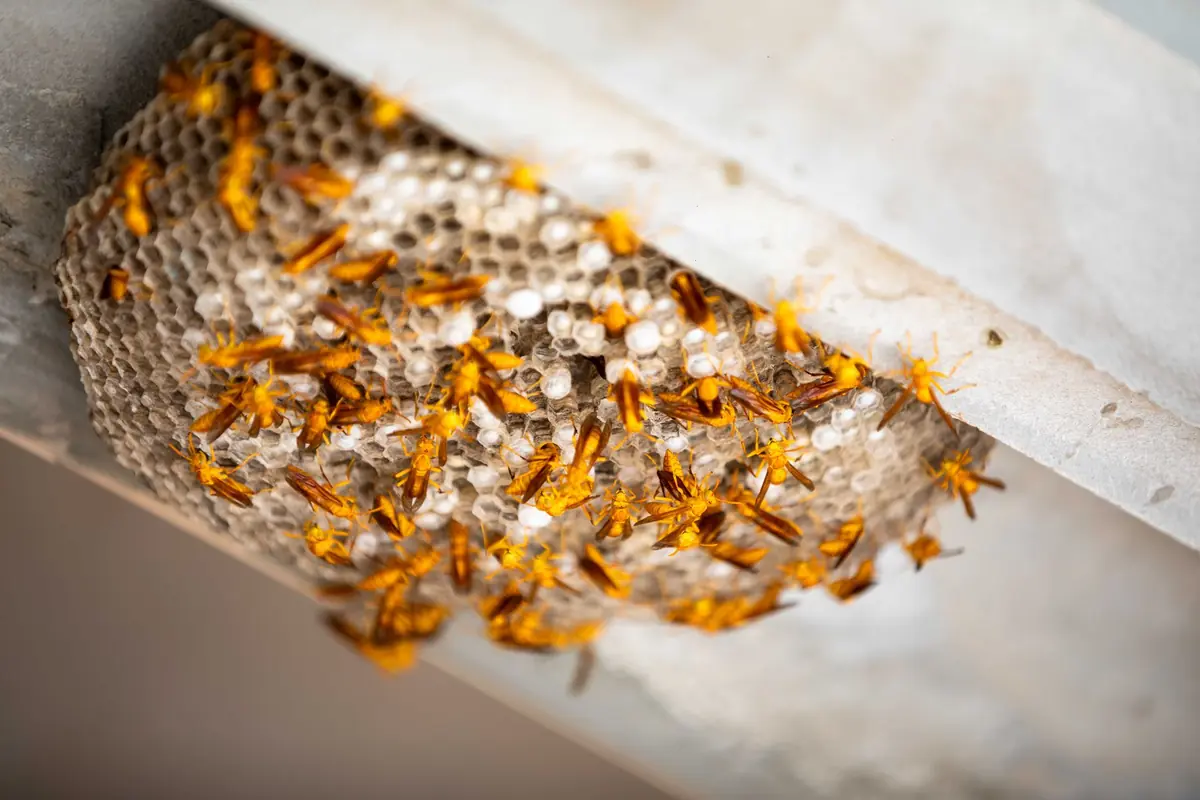
Paper wasps are the long-legged ones that fly with their back legs dangling and build open, grey, papery combs you can see the cells of. These are the ones that sting when you brush past. Mud daubers are slender, solitary wasps that build little tubes or pots of mud on walls and ceilings; they rarely sting and their nests can simply be scraped off. Our wasps profile has more on both.
If what you've got is building wax comb inside a cavity and is hairy rather than shiny, it's bees, and that's a bee removal job.
How we remove a nest
- Timing We come early or late in the day, when it's cooler and the foragers are home.
- Treatment The nest is treated directly with a product that kills the wasps quickly.
- Removal Once they're dead, we take the nest away if it's within reach; left up, the dead larvae rot in their cells and bring in ants.
- A look around Queens often start more than one nest nearby, so we check the rest of the stoep, eaves and outbuildings while we're there.
A wasp year in the Klein Karoo
A paper wasp nest lives for one season. The queen starts it on her own in early spring, hanging a handful of cells from a single stalk and rearing the first brood of workers without help. From then on the workers do the building, and the nest grows all through the hot months, reaching its biggest and most defensive in late summer. In autumn the colony raises new queens, they leave to find a winter hiding place, and the old nest dies. It isn't reused, but next spring's queens like the same kind of spot, often on the same stoep. That's why a quick look under the eaves in September saves a much bigger job in February.
Schools, guest houses and outdoor tables
A nest above a classroom door, over a guest's stoep or under a restaurant umbrella has to go quickly, and quietly. We work first thing, before the first guest is up or the first bell rings, or after the last table has left, and we check the undersides of tables, umbrellas, signboards and play equipment while we're there.
When you can leave it
A nest in a hedge at the far end of a big garden, or under the eaves of a shed nobody uses, does more good than harm. All summer the wasps pick caterpillars off your vegetables and vines. If nobody's at risk, leaving it is a perfectly sensible choice, and we'll tell you honestly if that's what we'd do.
What not to do
Don't knock a nest down with a broom, hose it, or burn it under a timber or thatched roof. Don't spray it from below with a can of insecticide while standing on a ladder: angry wasps and ladders are a bad mix. If someone is allergic, or is stung several times, get medical help straight away.
What it costs
One small nest on a single-storey stoep is a quick job. Several nests spread around a farmyard, or a nest high on a double-storey gable, takes longer. Number of nests, height and access decide the price.
The wasp removal page goes through the method in more detail, and pest control in Oudtshoorn covers everything else. Ring 044 012 5011 or tell us online how many nests you've spotted and where.
Frequently asked questions
Can I leave a wasp nest that's well away from the house?
Often, yes. They spend summer catching caterpillars on your vegetables and vines, so a nest nobody passes is doing you a favour.
Why are wasps building under our shade cloth?
It's shade and shelter in one, exactly the sort of spot a queen picks when she starts building after winter.
Do you remove wasps from farm sheds and machinery?
Yes, from sheds, workshops, pump houses and the frames and engine bays of parked machinery.
Are wasp stings worse than bee stings?
A wasp can sting more than once, though one sting is sore rather than dangerous for most people. Anyone allergic, or anyone stung many times, needs medical help.
Can you reach a nest high up on a double-storey house?
Yes. High eaves and gables are part of the job; tell us roughly how high the nest is when you book.
Do mud dauber nests need treating?
Usually not. Mud daubers rarely sting, and the empty mud cells can be scraped off the wall once the wasps have gone.