

Seeing ants, flies, fleas or little beetles in the pantry and want them gone? The short answer is that sprays on their own rarely finish the job. What works is finding where the insects are breeding or nesting, treating that spot directly, and then putting a barrier around the house so the next wave doesn't walk straight back in. That's the whole approach on one line, and the rest of this page explains how it plays out in Mossel Bay.
Two towns in one
Mossel Bay has a quiet residential and retirement side and a busy working side: the harbour, the fuel refinery, warehouses and the businesses that support them. The insects follow the same split.
In homes, it's mostly ants in the kitchen, fleas carried in by pets, fish moths in cupboards and the odd outbreak of pantry beetles in flour or cereal. On the working side, we deal more with flies around food handling and waste areas, cockroaches in kitchens and canteens, and stored product insects in anything that holds food or feed for a while.
The town is drier and windier than George, which helps a little, but it doesn't keep insects away. When the wind blows, flies and other flying insects shelter on the lee side of buildings, under patio roofs and in garages. Ants simply move their trails indoors, where it's calm and there's food.
Which insect is it?
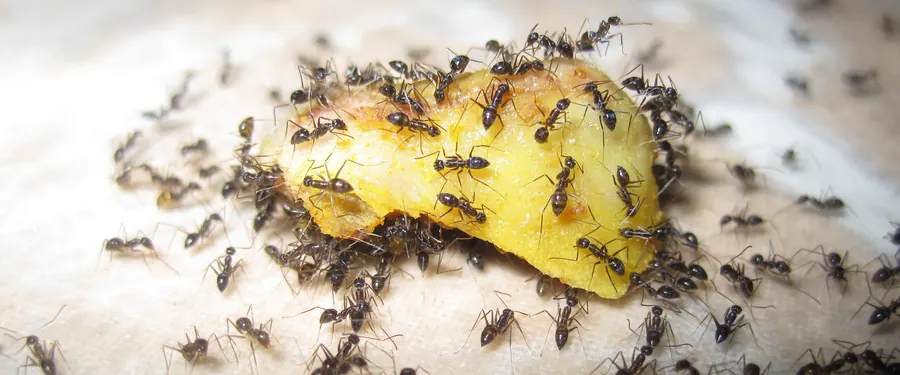
- Ants: trails along skirting boards, around the kettle or to the pet bowl. Small piles of sand between paving bricks are a sign the nest is close.
- Fleas: itchy bites around the ankles, a pet that won't stop scratching, or tiny dark insects that jump when you walk on a carpet.
- Flies: more than the usual handful, especially if they cluster around one bin, drain or corner of the yard.
- Fish moths: silver, fast and hiding in bookshelves, linen cupboards and boxes of old papers.
- Pantry insects: webbing in a bag of flour, small moths near the cupboard light, or beetles in the rice.
If you can't tell what you've got, our pest identification page will help you narrow it down before you call.
What happens when we come out
Looking before treating
We walk the house or premises first, inside and out. For ants we follow the trail back to the nest. For flies we look for what they're breeding in, because killing adults without removing the source is a losing game. For fleas we ask about pets and where they sleep. For pantry insects we check what's infested and what's just nearby.
Treating the cause
Ants get baits that the workers carry back to the nest, which is how a colony actually ends. Crawling insects get an odourless, non-staining residual spray along the routes they use, plus a protective barrier around the outside of the building. Fleas are treated where the pets rest and in the garden areas they use. Pantry insects are dealt with by clearing infested food and treating the cupboard.
Getting back to normal
You don't need to empty your cupboards or leave the house for a normal insect treatment. Once the sprayed surfaces are dry, they're safe for children and pets. If we find stored product insects deep inside sacks or bulk stock, which happens in warehouses and feed stores, fumigation may be the better tool, and our fumigation page for Mossel Bay covers how that works.
A local tip worth following
Mossel Bay is a fishing town, and a bag of fish scraps in the outside bin on a warm day is one of the fastest ways to start a fly problem. Wrap scraps tightly, double-bag them if the bin won't be collected soon, and rinse the cleaning area after you've gutted your catch. The same goes for the braai grid: scrape it while it's still warm rather than leaving it for the next weekend.
What most people get wrong
The common mistake is spraying the ants on the kitchen counter with a household aerosol. It kills the ones you can see and sends a chemical warning back down the trail, so the colony moves and pops up in a new spot a few days later. If you're going to try something yourself first, a store-bought ant bait left undisturbed will do more than a spray.
How much will it cost?
It depends on the insect, the size of the property and how long the problem has been building. A straightforward ant treatment in a house is a modest job. A flea problem that has spread through carpets and the garden takes longer. A business with flies or cockroaches in a kitchen usually works best on a regular service contract, so the problem never gets the chance to build up again. We'll quote after we've seen it, and we'll tell you honestly if a few baits and better bin habits will do the trick on their own.
Every treatment carries our 3-month guarantee, and we're SAPCA registered with more than 25 years in the Garden Route. For the wider picture, see insect control in George, or our general pest control in Mossel Bay.
If insects are getting the better of you, call 044 012 5011 and tell us what you're seeing.
Questions we get asked
Why do I still see a few ants after the treatment?
That's normal for the first few days. Ants keep feeding on the bait and carrying it home, so you may see some activity until the colony collapses. Leave the bait alone and don't spray over it.
Will my dog's flea treatment be enough on its own?
Usually not once fleas are established. Most of the population lives as eggs and larvae in bedding, carpets and the garden, so the pet and the places it rests both need treating.
Do you treat factories and warehouses near the harbour?
Yes. We do commercial and industrial insect control, including food handling areas, stores and warehouses, and can set up a scheduled service that fits your working hours.
Is the spray safe if I have a fish pond or aquarium?
Tell us about it before we start. Fish are sensitive to insecticides, so we keep the treatment well away from ponds and tanks and will ask you to cover an indoor aquarium while we work.
How long before I can wipe the kitchen surfaces?
Wipe food preparation surfaces as normal, but leave the treated skirting boards, cupboard edges and outside walls alone so the residual barrier keeps working.