

If insects keep turning up in your Dana Bay home, the answer is usually a barrier treatment around the outside of the house combined with baits for whatever is nesting, not a cupboard full of spray cans. Most of what comes inside here has walked in from the fynbos and the garden, so that's where we start.
A suburb built on the edge of the veld
Dana Bay is mostly newer family homes, and a lot of them sit right up against natural fynbos. That's a big part of the suburb's appeal, but it also means your boundary wall is the front line. Ants forage across from the veld, spiders follow the insects that gather around outside lights, and on a still, warm evening flying insects head for every lit window. Being on the coast, the air is often damp too, which suits fishmoths in cupboards and bookshelves.
A newer house isn't automatically a sealed one. Gaps where plumbing comes through the wall, weep holes, garage doors that don't quite meet the floor and sliding doors left open for the breeze all let insects through.
What Dana Bay families usually call us about
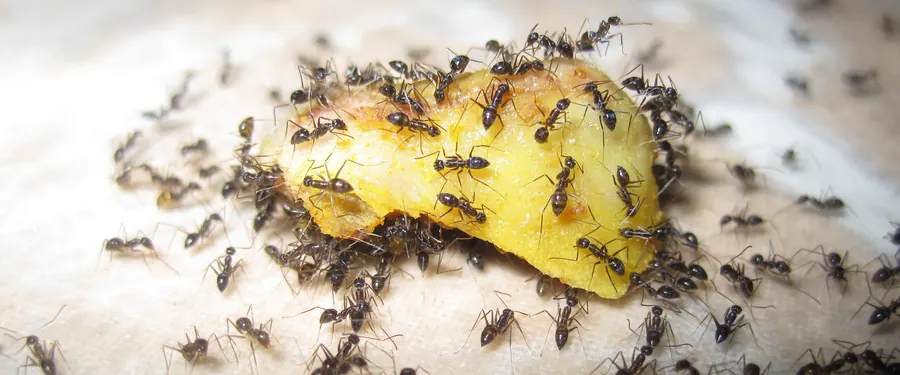
- Ant trails along skirting boards, into the kitchen or towards the dog's bowl, often after rain or a hot spell.
- Spiders in garages, under eaves and in the corners of rooms that face the veld.
- Fleas, nearly always linked to a family dog or cat.
- Fishmoths in linen cupboards, bookshelves and boxes stored in the garage.
- Weevils and pantry moths in flour, cereal, pet food or birdseed.
- Cockroaches, less often, though they do turn up. We cover those separately on our page about cockroach control in Dana Bay.
How we treat a house here
The first part of the visit is looking, not spraying. We walk the outside of the house and the boundary closest to the fynbos, find where the trails start, check the garage and the roof line, and ask you where and when you see things. Insects coming in from outside are treated differently from ones breeding indoors, so this step decides everything that follows.
Then we treat in layers:
- An outside barrier around the foundations, door frames, window sills and weep holes, using an odourless, non-staining residual spray.
- An inside barrier along skirting, behind appliances and in the places insects hide during the day.
- Ant baits, placed where the workers will find them and carry them home. That's what finishes the nest, which may be under your paving or out in the veld.
- Targeted work for fleas, fishmoths or pantry insects, depending on what we found.
You don't have to empty the kitchen cupboards or take the family out for the day. Once the treated surfaces are dry, they're safe for children and pets.
A prevention tip that works in Dana Bay
Keep a bare strip between the house and the plants. Where fynbos, shrubs or bark mulch grow right up to the walls, insects have a sheltered, damp path straight to your weep holes and door frames. A strip of paving, gravel or plain open ground, even half a metre wide, takes that path away and helps the barrier treatment do its job. Add a seal to the bottom of the garage door and you've closed the two routes we see most often.
Beyond that, store pet food and birdseed in sealed containers, sweep up under the braai, and switch off outside lights you don't need, so you aren't drawing every flying insect in the street to your front door.
What people get wrong
Spraying the veld. It's a natural reaction when the ants seem to come from out there, but you can't treat the fynbos, and you shouldn't try. The useful line to hold is the house itself. Insects living in the veld aren't your problem. Insects crossing your threshold are.
What will it cost?
The price depends on the size of the house and garden, which insects we're treating and how settled they are. A single ant problem in a three-bedroom house is quick. Fleas spread through carpets, or ants plus spiders plus a pantry clean-out, take longer. If you only see a short ant trail now and then, a shop-bought ant bait and a wipe-down with soapy water may genuinely be enough, and we'll tell you that. When it keeps coming back, or you can't find the source, that's when a proper treatment earns its keep. We quote before we start, and the work carries our 3-month guarantee.
We're SAPCA registered and have been working in the Garden Route for more than 25 years. For the wider picture in the suburb, see pest control in Dana Bay, or read more about our methods on the insect control in George page. When you're ready, call 044 012 5011 and tell us what you're seeing.
Questions we get asked
Will the treatment harm the fynbos or the birds?
No, because we don't spray the veld. Treatment goes on the house itself: foundations, frames, weep holes and inside along the skirting, with ant bait placed in small amounts on the trails.
Why do I get more ants after rain?
Rain floods ant nests, so colonies move to higher, drier ground, and a warm kitchen with food in it is ideal. A barrier and baits deal with both the trail and the nest.
Do you treat garages and outbuildings too?
Yes, and in Dana Bay we usually should. Garages are where spiders, fishmoths and pantry insects in stored pet food tend to build up before they reach the house.
Do I need to treat my dog for fleas as well?
Yes. We treat the house, and your vet can recommend a product for the pets. Doing one without the other lets the flea cycle carry on.
How long does the barrier treatment hold?
Our treatments carry a 3-month guarantee. How long it holds beyond that depends on rain, garden watering and whether the treated paving and walls get washed down.
Can we stay home while you treat?
Yes. There's no need to leave or unpack cupboards. Keep children and pets off treated surfaces until they're dry, then carry on as normal.