
Is it worth calling someone out for a few ants and spiders? In Glentana, often yes, because what you're seeing is usually the edge of something bigger: a nest in the garden, a gap behind the sliding door or a deck light that draws in insects every night. A single, well-aimed treatment, backed by a couple of small changes around the house, tends to sort it out for the season.
Why insects like a cliff-top village
Glentana is a small coastal village on the cliffs between Groot Brak River and Herolds Bay. Most homes are holiday or retirement houses, many with wide windows and decks facing the sea, and most are surrounded by coastal bush. That bush is full of insect life, and the house is the nearest dry, sheltered spot with food in it.
The other Glentana factor is how the homes are used. A holiday house that stands closed between visits gives ants and fish moths weeks of quiet. A retirement home with a garden and a dog or cat has its own patterns, usually fleas and ants. Both need slightly different handling.
The usual suspects
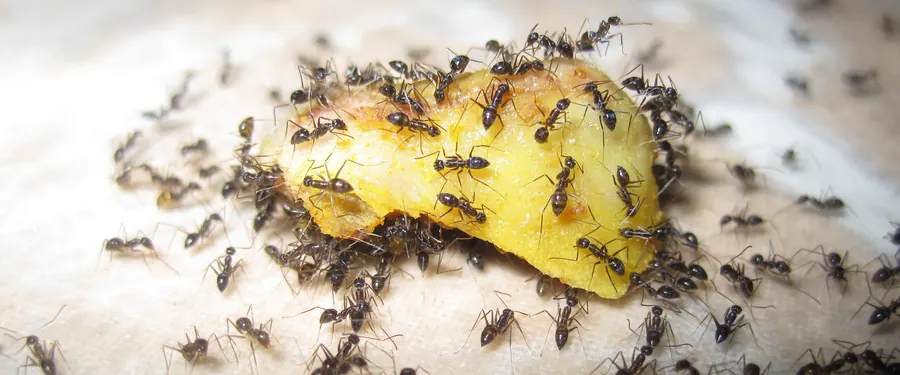
- Ants coming in from the sandy soil and bush, especially into kitchens and around pet bowls.
- Spiders on decks, in window frames and under eaves, often in numbers that follow the insects attracted to outside lights.
- Fleas in homes with pets that come and go through the garden.
- Fish moths in linen cupboards, bookshelves and boxes, helped along by sea air and closed-up rooms.
- Flies around the braai area and the bins after a busy weekend.
- Pantry insects in flour, rice and pet food that's been left in the cupboard between visits.
The treatment, in plain terms
We don't arrive and spray everything. First we look. We walk round the outside to see where the bush meets the house, find ant nests and trails, look at the deck, windows and eaves for spider activity, and check the lights. Inside, we look at the kitchen, the cupboards, any rarely used rooms and where your pets sleep.
Then we treat what we found. An odourless, non-staining residual spray goes on as a protective barrier inside and outside, along skirting boards, door and window frames and the base of the walls. Ants get baits that are carried back to the nest. Flea treatment covers pet resting spots indoors and the parts of the garden they use. If pantry insects are the problem, we help you sort out which food needs to go and treat the cupboard.
There's no need to empty cupboards or leave the house for this kind of treatment. Once the spray has dried, the treated areas are safe for children, grandchildren and pets.
A Glentana tip: watch your lights
On a still evening, a bright white light on a sea-facing deck can pull in insects from across the bush, and spiders quickly set up shop where the food is. Switch outside lights off when you're not using them, fit warm or yellow-toned bulbs that attract fewer insects, and put motion sensors on security lights. You'll notice fewer cobwebs within a few weeks.
What people get wrong
Brushing away cobwebs every week and calling it spider control. Removing webs is fine, but the spiders come back because their food is still arriving. Fix the lights and treat the insects, and the spiders mostly sort themselves out.
The other common mistake is spraying a household aerosol straight onto an ant trail. It scatters the colony and makes it harder to treat. If you want to try something yourself first, use an ant bait and leave it alone for a few days.
How much will it cost?
The price depends on the size of the house and garden, what insects we're treating and how long they've been there. A standard treatment for ants or spiders in a home is fairly straightforward. A flea problem that has spread through the house and garden, or a large home with several decks, takes longer. If the house is a holiday home, a treatment timed just before you arrive can be worth doing each season. We'll quote first, and we'll be honest if a bait station and a change of light bulbs will get you most of the way.
We're SAPCA registered, we've worked in the Garden Route for more than 25 years and our treatments have a 3-month guarantee. If rodents are part of the picture, see rodent control in Glentana. For general pest work in the village, there's pest control in Glentana.
Give us a ring on 044 012 5011 and we'll find a time to come out.
Questions we get asked
Will the spray stain my wooden deck or window frames?
No. We use non-staining residual sprays that dry without marks on timber, paint or tiles.
Are the spiders in Glentana dangerous?
Most spiders found around homes here are harmless and even help by eating other insects. If you're worried about a particular one, send us a photo or check our identification guide.
Can you treat while I'm living in the house?
Yes. You can stay home during the treatment. Just keep children and pets off treated areas until they're dry.
How long does the barrier keep working?
Residual treatments keep working for weeks, and our work carries a 3-month guarantee. Heavy rain on outside walls and frequent washing of treated surfaces will shorten that.
Why do I get fish moths when the house is closed up?
Fish moths like still, slightly damp, undisturbed places. A closed holiday home near the sea is ideal for them, so airing the house and keeping paper and fabric stored off the floor helps.